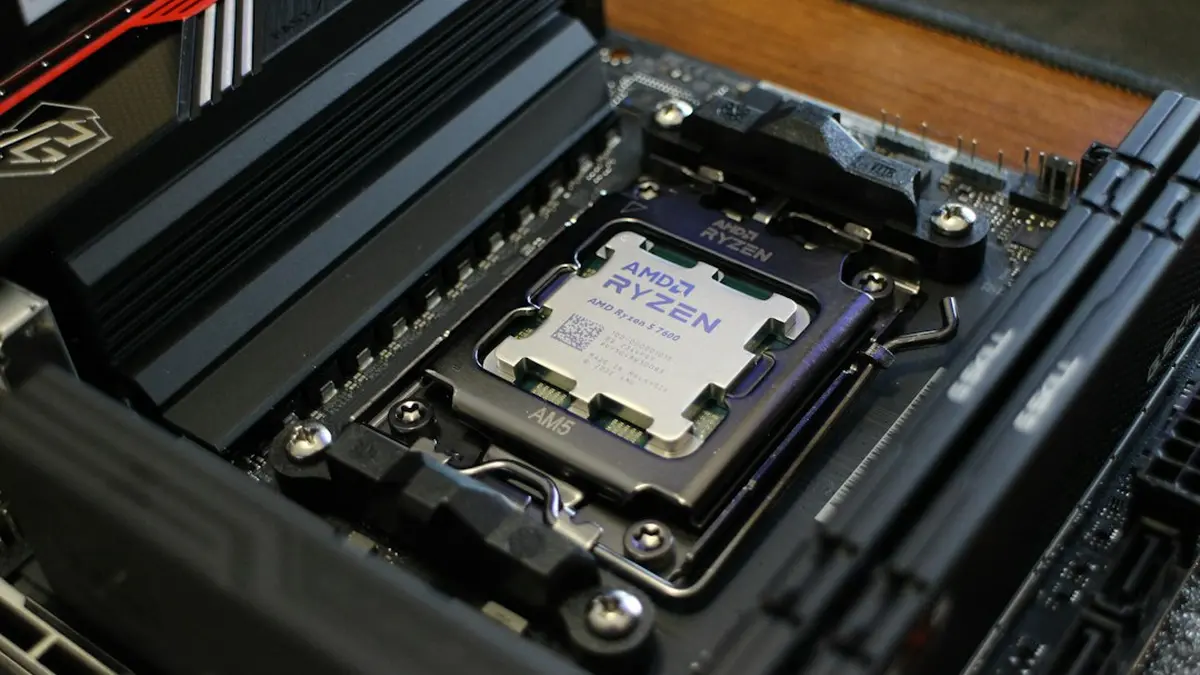
The 2L-ILM on Intel's LGA1954 socket is the clamp that presses the CPU onto its pins, now with two levers instead of one. It is a separate piece of hardware from the four holes your cooler bolts through. That separation is the whole compatibility question for Nova Lake-S. The new socket forces a new motherboard and a new CPU. Whether it forces a new cooler depends on the bolt pattern and on the surface the cold plate sits on, and so far the bolt pattern has not moved.
Intel's own confirmation of the socket was accidental. It came through an engineering validation tool listed on the company's website, which ties LGA1954 to Nova Lake-S, as TechPowerUp reported. The same report puts launch around Q1 2027, which is later than the second-half-2026 window earlier coverage pointed to. None of the sources cited here include a core count or a minimum retention-force spec from Intel, so neither figure appears below.
Two levers, one load plate
LGA1700 and LGA1851 use a single lever. It closes a load plate over the package and pushes down from one hinged side. On those platforms the uneven pressure was blamed for bowed heat spreaders, the problem the community called bend-gate.
The 2L-ILM, according to Intel documentation quoted by igor'sLAB, consists of "a frame, a load plate, and two levers." Its stated purpose is to "apply as even a load as possible to the heat spreader while simultaneously reducing the actuation force per lever." Splitting the closing force between two levers means neither side has to do all the work, and the load plate comes down more evenly. A flatter heat spreader is the payoff that matters to anyone holding a cooler, because a flat IHS meets a flat cold plate across its whole area. A bowed IHS only meets it in the middle.
This is not new engineering. Intel used dual-lever ILMs on server and HEDT sockets, including LGA2011 in the X99 era around 2014. What is new is putting one on a consumer board.
The flatness benefit is Intel's claim, relayed through leaks. Checking it independently would take IHS flatness measurements on the same chip under both clamp types. Nobody has published those yet.
Around the clamp, the socket grows to 1,954 contacts, up 103 (about 5.6%) from LGA1851. Shipping manifests reported by Tom's Hardware put the outline at 45mm x 37.5mm, the same as LGA1851 and LGA1700. The extra pins reportedly fit by making the layout more square inside an unchanged outline.
Three places it shows up
On the board you buy. The 2L-ILM is expected only on higher-end motherboards. Cheaper boards are expected to keep a single-lever design, the refined RL-ILM variant already used on LGA1851. The 900-series lineup reported so far is Z990 and Z970 for enthusiasts, B960 for mainstream builds, and Q970 and W980 for business and workstation machines. Which of these carry which clamp has not been confirmed. A leaked Nova Lake-S package photo suggests the CPU is built to work with either retention type.
On the cooler vendor's support page. Noctua's FAQ states: "All Noctua CPU coolers compatible with LGA1851 and LGA1700 are also compatible with Intel's upcoming LGA1954 socket. No additional mounting parts are needed." It tells owners to "follow the installation steps for LGA1700/LGA1851, as the installation process is identical." That makes three consecutive Intel desktop sockets on one mounting standard. Noctua lists a small number of exceptions among its low-profile models. Thermaltake has indicated similar compatibility, but only through a leaked installation guide.
On the CPU itself. According to TweakTown's report on a leaked package photo, the alignment notch moves from the left edge to the right, and the package size changes. A Nova Lake-S chip will not physically drop into an LGA1700 or LGA1851 board. Intel already did this once: its support documentation says LGA1700 mounting holes are "designed to be mechanically compatible with the LGA1851 socket," while the CPUs themselves are not interchangeable between the two.
Not the cooler mount
| Retention mechanism (ILM) | Cooler mount | |
|---|---|---|
| What it holds | The CPU against the socket pins | The heatsink or pump block against the IHS |
| Changed on LGA1954? | Yes, two levers on higher-end boards, one lever on mainstream boards | No, outline still 45mm x 37.5mm |
| Who supplies it | The motherboard maker | The cooler maker |
| What it decides for you | Which board to buy | Whether your current cooler bolts on |
Before you reuse the cooler
Bolting on is the easy part. Intel says on LGA1851 that mechanical fit does not guarantee optimal thermal performance, and it tells owners to ask their cooler vendor. Two details that decide contact quality are still unconfirmed: IHS height and hot-spot placement. A new die layout can move the hot spot away from where a cold plate does its best work, even when every screw lines up.
-
Confirm your cooler is listed for LGA1700 or LGA1851
If it is, the bolt pattern matches LGA1954. If it predates LGA1700, it needs whatever kit its maker offers for that socket first.
-
Find your own vendor's LGA1954 statement
Noctua's FAQ covers Noctua coolers only. The shared footprint makes other brands likely to fit, but likely is not a support page.
-
Check low-profile and back-mounted-screw designs individually
These are the designs that showed up as exceptions or were flagged for separate verification.
-
Wait for IHS height and hot-spot data before judging thermals
An earlier Club386 report warned that a TDP increase or hot-spot shift could still prompt new mounting kits. That warning came before the compatibility confirmations, but the thermal questions behind it are still open.
-
Budget for a board and CPU regardless
Neither carries over. Whether you get two levers or one depends on the board tier, and it has no effect on whether your cooler fits.
Comments
No comments yet. Be the first to comment!
Leave a Comment