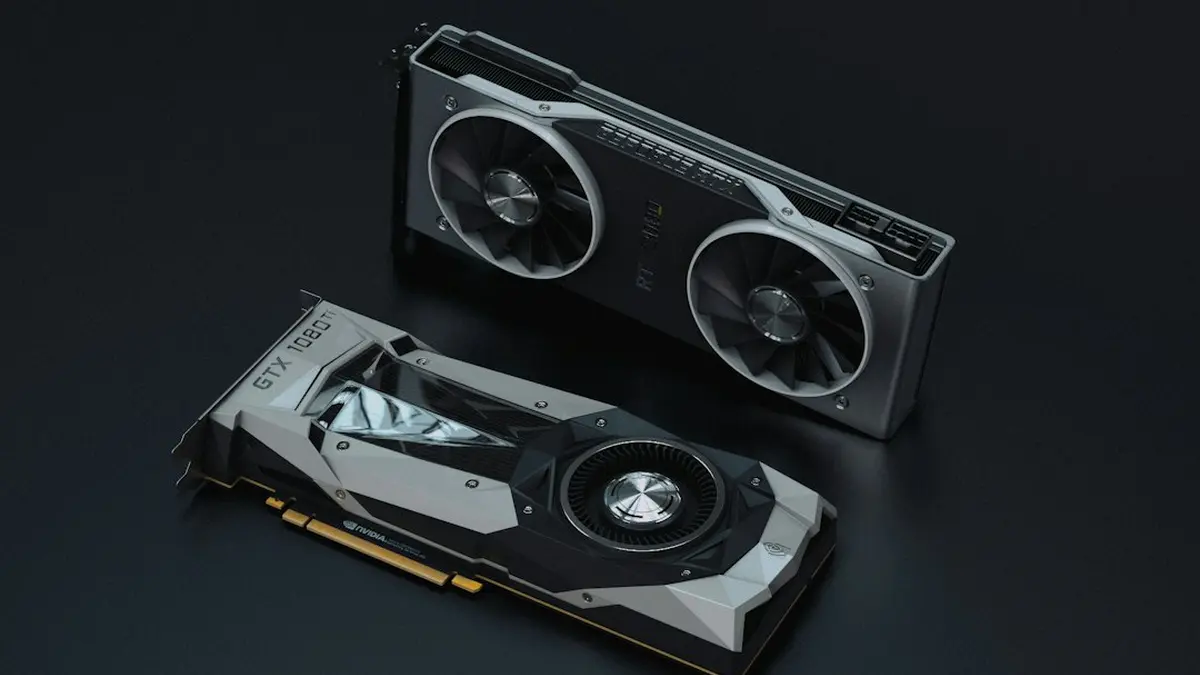
For most buyers the RX 9060 XT 16GB is the card to get. It launched $30 cheaper, and in Tom's Hardware's review it leads the RTX 5060 Ti 8GB by 13 to 14 percent at 1080p and about 28 percent at 1440p Ultra, because the Nvidia card runs out of memory. The RTX 5060 Ti 8GB wins only when the work fits inside 8GB: lighter 1080p games, Cyberpunk 2077 with ray tracing off, and small local language models, where it is about 21 percent quicker.
So the choice is not really which GPU is faster. It is how often you expect to hit 8GB, and every source gathered here says that will happen more often from now on.
The numbers side by side
| NVIDIA GeForce RTX 5060 Ti 8GB | AMD Radeon RX 9060 XT 16GB | |
|---|---|---|
| VRAM | 8GB | 16GB |
| Launch price | $379 | $349 (board-partner cards only) |
| Released | April 16, 2025 | June 5, 2025 |
| Cyberpunk 2077 1080p Ultra, Tom's Hardware | 86.7 fps (June 24, 2026) | 79.2 fps (June 2, 2026) |
| Cyberpunk 2077 1440p Ultra, Tom's Hardware | 50.1 fps (June 24, 2026) | 47.2 fps (June 2, 2026) |
| Cyberpunk 2077 4K Ultra, Tom's Hardware | 20.8 fps (June 24, 2026) | 20 fps (June 2, 2026) |
| Cyberpunk 2077 1440p Ultra + Ultra RT, Tom's Hardware | 21.3 fps (June 24, 2026) | 24.8 fps (June 2, 2026) |
| Launch price per frame, Cyberpunk 2077 1440p Ultra | $7.56 | $7.39 |
| Launch price per frame, Cyberpunk 2077 1440p Ultra RT | $17.79 | $14.07 |
| Game suite average at 1440p Ultra, Tom's Hardware RX 9060 XT 16GB review | Baseline | About 28% faster |
| LLaMA 2 7B tokens/sec, Tom's Hardware RX 9060 XT 16GB review | About 21% faster | Baseline |
The Cyberpunk figures come from two Tom's Hardware pages: the Nvidia card's from the GPU hierarchy dated June 24, 2026, and the AMD card's from the RX 9070 GRE review dated June 2, 2026 (the ray tracing result is on page 5). Same publication, different articles. Treat a gap of a few frames between them as something less than a measured result. The suite averages and the LLM result come from Tom's Hardware's RX 9060 XT 16GB review, where both cards ran on the same bench.
None of the sources gathered here give shader counts for both cards, AMD's bus width or board power, or 1% lows for this exact pairing, so the table leaves them out. The compare tool has every figure the hub holds for each card.
RTX 5060 Ti 8GB and RX 9060 XT 16GB in the hub
| RTX 5060 Ti 8GB | RX 9060 XT 16GB | |
|---|---|---|
| Price | $379launch price; no Founders Edition | $349launch price (AMD); board-partner cards only |
| GPU | GB206 | Navi 44 |
| Architecture | Blackwell | RDNA 4 |
| Shaders | 4608 | 2048 |
| Boost clock | 2570 MHz | 3130 MHz |
| Cyberpunk 20771080p Ultra, fps | 86.7 | 79.2 |
| Cyberpunk 20771440p Ultra, fps | 50.1 | 47.2 |
| Cyberpunk 20774K Ultra, fps | 20.8 | 20 |
| Cyberpunk 20771440p Ultra + Ultra RT, fps | 21.3 | 24.8 |
| Alan Wake 21440p Ultra, fps | 38.5 | 37.2 |
| Black Myth: Wukong1440p Very High, fps | 38.6 | 37.1 |
| Buy | Check price on AmazonCheck price at Best Buy | Check price on AmazonCheck price at Best Buy |
Figures as published by Tom's Hardware (Jun 2, 2026), Tom's Hardware (Jun 2, 2026), Tom's Hardware (Jun 24, 2026). The best figure is marked where a row is all one source.
Compare every benchmark side by sideNVIDIA GeForce RTX 5060 Ti 8GB
The GeForce RTX 5060 Ti 8GB is a decent GPU with too little memory. With nothing pushing it past 8GB, it does well. Tom's Hardware has it at 86.7 fps in Cyberpunk 2077 at 1080p Ultra and 50.1 fps at 1440p Ultra (June 24, 2026), both ahead of the AMD card's figures. The same outlet's review found it up to 8 percent faster in lighter 1080p titles that don't fill its memory.
Once the memory fills, things go badly. Tom's Hardware says several games "almost fail to run" on it at 1440p and 4K. Its review puts the AMD card about 28 percent ahead at 1440p Ultra and around 70 percent ahead at 4K Ultra, and blames memory capacity rather than compute. Cyberpunk shows the same thing in miniature: with Ultra ray tracing on at 1440p, the Nvidia card falls to 21.3 fps, behind the AMD card's 24.8. That is backwards from what Nvidia's ray tracing hardware should produce, and it fits with the 8GB buffer being the limit rather than the RT cores.
Nvidia's ray tracing hardware and DLSS are both better than AMD's, and Tom's Hardware says so. The headline frame generation result, though, is Club386's Cyberpunk 2077 1440p test: 116 fps against 52 with upscaling and frame generation on. That test used the RTX 5060 Ti 16GB, not this card. No source here shows the 8GB card's frame generation results in the same game.
Price: $379 at launch. Best Buy's Tech Fest sale took the MSI GeForce RTX 5060 Ti 8G Gaming OC from $409.99 to $359.99, a sale that Windows Central said ended around March 22, 2026. That was a promotion, not the regular price. Windows Central described the card as "driven to overpriced obscurity" outside such deals. For the current figure, check the price on Amazon or at Best Buy.
It makes sense for someone who plays esports or older games at 1080p and has a CUDA-only AI workload that fits in 8GB.
AMD Radeon RX 9060 XT 16GB
The Radeon RX 9060 XT 16GB won an Editor's Choice award from Tom's Hardware. Its review called it "the far better and more attractive mainstream GPU option" and said the 16GB buffer makes the 8GB RTX 5060 Ti "look shortsighted." On that bench it leads by 13 to 14 percent at 1080p, about 28 percent at 1440p Ultra and around 70 percent at 4K Ultra. Tom's Hardware also reports it 48 percent faster in some content-creation tests.
Its weak points are the usual AMD ones. Ray tracing is still behind Nvidia's, and FSR trails DLSS. Results also depend heavily on the game. TechSpot found it 11 percent ahead in Oblivion Remastered at 1440p Ultra and 5 percent behind in Clair Obscur: Expedition 33, though it doesn't say which RTX 5060 Ti memory variant it compared against. Tom's Hardware's 16GB review didn't hold up the $349 in its reports either: a UK-specific page put street prices from around $389, and a Newegg discount code briefly brought it down to $379, the 5060 Ti 8GB's launch price. Neither of those prices is dated in the sources, and no Best Buy price for this card is among them.
It makes sense for anyone gaming at 1440p, playing with ray tracing on, or running AI models bigger than 8GB.
Where the 8GB wall sits
The first difference is memory, and in Tom's Hardware's data it decides almost everything. The gap between these cards grows with resolution: 13 to 14 percent, then 28, then about 70. Extra shaders don't produce that curve. Running out of VRAM does. A different Tom's Hardware test set put AMD 16 percent ahead at 1440p and 21 percent at 4K. That is smaller, but it rises the same way. For the identical Nvidia chip with double the memory, see how the same chip with 16GB changes the result.
The second difference is local AI, and here the two directions cut against each other. Tom's Hardware measured the RTX 5060 Ti about 21 percent faster in tokens per second on LLaMA 2 7B and 25 percent faster on SPEC WS4.0 GPU inference. Both workloads fit in 8GB. In a memory-heavier test, the same review found the 8GB card's performance "collapsed drastically" while the 16GB Radeon kept going. RunAIHome adds that CUDA works out of the box on any operating system, while ROCm on Windows often needs a manual HIP SDK setup. In short, Nvidia is faster on models that fit in its memory, and AMD can run models that don't fit on Nvidia at all. The LLM fit tool will tell you which group the models you use fall into.
The third difference is power, and the sources only cover half of it. RunAIHome lists the RTX 5060 Ti at 180W and says a 650W power supply is enough. No source here gives the RX 9060 XT 16GB's board power, so a watt-for-watt comparison isn't possible from these facts. Tom's Hardware's review doesn't make power a deciding factor either way.
The PCIe lane penalty on 8GB cards, along with Indiana Jones and the Great Circle results for this exact pair, isn't covered by the sources gathered here, so it isn't argued here.
At what price the answer flips, in Cyberpunk 2077 at 1440p
These figures are Tom's Hardware's: RTX 5060 Ti 8GB at 50.1 fps raster and 21.3 fps with Ultra RT (June 24, 2026), RX 9060 XT 16GB at 47.2 and 24.8 (June 2, 2026). The AMD card is held at its $349 launch price.
| Nvidia raster lead, 50.1 / 47.2 | 6.1% |
|---|---|
| Nvidia price that matches AMD per raster frame, $349 × 50.1 / 47.2 | $370 |
| Nvidia per raster frame at Best Buy's $359.99 sale price (March 2026) | $7.19 vs $7.39 |
| AMD ray tracing lead, 24.8 / 21.3 | 16.4% |
| Nvidia price that matches AMD per RT frame, $349 × 21.3 / 24.8 | $300 |
| Nvidia per RT frame at $359.99 | $16.90 vs $14.07 |
In this one game with ray tracing off, the RTX 5060 Ti 8GB is better value per frame below about $370, and the March sale price cleared that. Turn ray tracing on and it would need to cost about $300 to match. Across Tom's Hardware's full 1440p suite, where the Radeon is about 28 percent ahead, Nvidia's break-even price falls to about $273. That is $26 below the launch price of the plain RTX 5060.
Verdict
For 1440p gaming, 4K, ray tracing, or any AI model that might grow past 8GB, buy the RX 9060 XT 16GB. Over a full game suite it is faster by more than the price gap, and the gap gets wider each time a game uses more memory. Tom's Hardware's own conclusion was blunter: "Spend the extra money and avoid all 8GB cards." Here you don't even have to spend extra.
Buy the RTX 5060 Ti 8GB only if all three of these are true: you play at 1080p in games that don't fill 8GB, your local AI work is small CUDA models where the 21 percent lead counts, and you can get it for about $360 or less while the Radeon costs $349 or more. If you want Nvidia's features and can stretch further, the 16GB Nvidia card is the better target, and our 16GB against 16GB comparison covers what it costs.
One caveat. The most recent figures here are from June 2026. No head-to-head of these two cards dated October or November 2026 turned up, so check today's prices before applying the break-even numbers above. The rest of the field is on the graphics cards page.
AMD Radeon RX 9060 XT 16GB
- Cyberpunk 2077 1080p Ultra 79.2 fps Tom's Hardware, Jun 2, 2026
- Cyberpunk 2077 1440p Ultra 47.2 fps Tom's Hardware, Jun 2, 2026
NVIDIA GeForce RTX 5060 Ti 8GB
- Cyberpunk 2077 1080p Ultra 86.7 fps Tom's Hardware, Jun 24, 2026
- Cyberpunk 2077 1440p Ultra 50.1 fps Tom's Hardware, Jun 24, 2026
Comments
No comments yet. Be the first to comment!
Leave a Comment