Buy the standard EXPO DDR5-6000 CL30 kit unless the EXPO ULL version of the same SKU sits within roughly ten percent of it, which at the loosest CL36 tier it does and at the tight tiers it emphatically does not. TweakTown's Newegg pricing check put G.Skill's Trident Z5 NeoX 32GB DDR5-6000 C26 at $1,099.99 against $699.99 for the standard-EXPO version of the same kit, a 57 percent premium, with the C28 tier at $999.99 against $559.99 for a 79 percent premium.
What the surcharge buys is about 8 nanoseconds of AIDA64 memory latency and, on a non-X3D Ryzen at 1080p, somewhere between nothing and 15 percent more frames, depending on which lab you read and, more importantly, what they compared against. On an X3D chip it buys almost nothing at all, and AMD says so itself.
What separates the two profiles on paper
| Specification | Standard EXPO DDR5-6000 CL30 | EXPO ULL DDR5-6000 C26 (Trident Z5 NeoX) |
|---|---|---|
| Rated speed | DDR5-6000, 1:1 UCLK=MCLK | DDR5-6000, 1:1 UCLK=MCLK |
| Primary timings | CL30 | CL26-36-36-32 (Tech Times) |
| tRAS (TweakTown) | 96 cycles | 32 cycles |
| tREFI refresh interval (Tech Times) | ~3,892 ns | ~15,569 ns |
| Profile voltage (TweakTown) | 1.40 to 1.45 V | 1.35 V |
| AIDA64 memory latency, class-representative kits (Hardware Busters) | 79.4 ns | 71.4 ns |
| Platform requirement (Notebookcheck) | Runs on existing AM5 EXPO support | AGESA BIOS update, X870 and B850 boards |
| Newegg list price, same NeoX SKU, September 2026 (TweakTown) | $699.99 | $1,099.99 |
| AMD's own average FPS claim vs JEDEC DDR5, 30+ games on a 9700X (TweakTown) | Not claimed by AMD | 13% average, 15% in 1% lows |
The evidence base here is unusually messy for a memory launch, and it is worth saying why before the numbers get quoted at you. Five independent outlets have published EXPO ULL gaming results and they do not agree: TechSpot recorded 7 to 8 percent on a Ryzen 7 9700X, Guru3D put the ideal-case range at 3 to 6 percent, PC Games Hardware landed at 2.6 to 3.8 percent in most titles, and LTT Labs found 1 to 2 percent in Cyberpunk 2077 and a flat zero in Alan Wake 2. The spread tracks the baseline kit, not the ULL kit. PCGH ran its comparison against a Hynix A-die CL28 reference and a budget Micron D-die CL36 kit on a Ryzen 5 9600X, ASRock X670E PG Lightning and an RTX 5090. Compare ULL to a well-binned CL28 and the delta is small; compare it to a loose budget kit and the delta looks like a product.
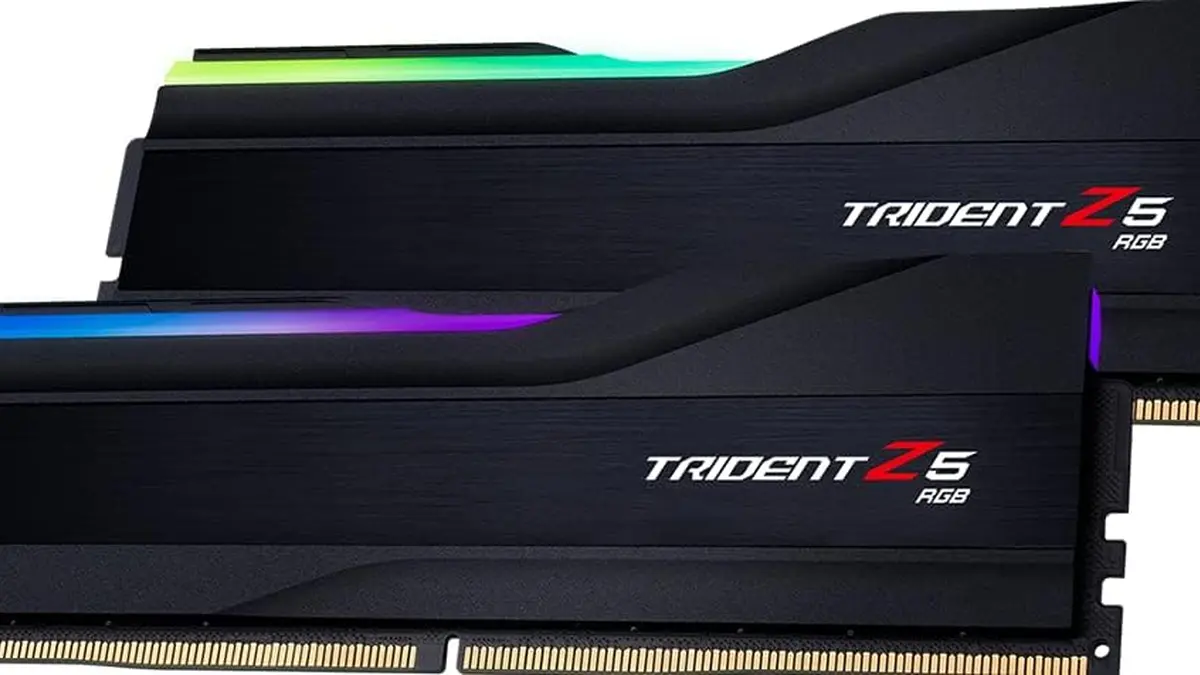
G.Skill Trident Z5 RGB Series DDR5-6000 CL30
This is the configuration every one of those labs used as its control: DDR5-6000, CL30, standard EXPO, running 1:1 with the Infinity Fabric. Overclock.net's AM5 tuning threads still call DDR5-6000 in 1:1 mode the practical sweet spot for Ryzen 7000 and 9000 parts, and nothing in the ULL launch changes that, because ULL is certified for 6000 and 6400 MT/s and does not move the frequency at all. It tightens sub-timings on a speed grade you were already going to buy.
In Hardware Busters' AIDA64 run, an untouched CL30 kit measured 79.4 ns. That is the number the entire ULL pitch is aimed at, and it is also the number a motherboard BIOS toggle can close most of, which is covered below. The kit carries a 4.3 out of 5 rating across 49 Amazon reviews, and at $1,159.00 it costs more than the $1,099.99 Newegg list TweakTown recorded for the C26 ULL NeoX, which tells you more about the state of DRAM pricing than about ULL. We went through what the shortage has done to this segment when we looked at which $400 kits still hit CL30. The percentage premiums in the table are same-retailer, same-SKU pairs; across retailers, the ordering can and does invert, so price both before you commit.
Buy this one if you are on an X3D chip, if you game above 1080p, or if the ULL version of whatever kit you are looking at costs more than about ten percent extra.

The ULL profile, and what it costs to get it
AMD describes EXPO ULL as automatic low-latency overclocking. What it is, mechanically, is a validated preset that stretches tREFI from roughly 3,892 ns to roughly 15,569 ns and drops tRAS from 96 cycles to 32, plus a handful of other sub-timing changes. PCGH counted five adjusted sub-timings on the CL36 kit (tRAS, tRFC, tREFI, tRRD_S, tWR) and seven, tuned harder, on the CL30 kit. PCGH also notes the obvious: EXPO has permitted exactly this kind of sub-timing work since its introduction in 2020. ULL is a bin and a preset, not a new memory technology.
The profile needs an AGESA update on X870 and B850 boards. Notebookcheck lists eight launch partners (G.Skill, Kingston FURY, KLEVV, Lexar, TeamGroup, V-Color, XPG and Origin Code) with kits arriving from June 2026. G.Skill's retail lineup spans the budget Flare X5X CL36 at an estimated $509.99 up to the Trident Z5 Royal NeoX in four tiers, CL26-36-36-32 at the tight end down to CL36-36-36-76. Within that lineup, Tech Times calculates first-word latency at 8.67 ns for CL26 against 12.0 ns for CL36, a 3.33 ns gap, and cites community testing showing 1 to 4 percent in CPU-bound gaming for that step. Overclock.net testers, working on Hynix M-die NeoX kits, called the bin "second to none" and the frame-rate gains "not insignificant," mostly as reduced stuttering rather than higher peaks.
AMD told the press these kits would be "effectively the same price" as standard EXPO. Tom's Hardware filed the $1,099 launch price under the heading "80 percent ULL tax." Both statements cannot be true.
Why the published FPS numbers disagree
AMD's headline is 13 percent average FPS and 15 percent better 1 percent lows across 30-plus games on a Ryzen 7 9700X. That is measured against JEDEC DDR5, which nobody reading this runs. Buried in the same deck is the comparison that matters, ULL against standard EXPO at the same speed: 4 percent average, 4 percent in 1 percent lows. One reviewer characterised the JEDEC framing as comparing a Civic Type R to a go-kart, and that is roughly the size of it.
Against that 4 percent, the independent results cluster in three bands. TechSpot's 9700X runs showed the CL36 ULL kit 7 percent faster and the CL30 ULL kit 8 percent faster than standard EXPO, with a best case of 121 to 139 fps and 1 percent lows from 91 to 107. Tech Times' Flare X5X coverage reports 15 percent in Baldur's Gate 3, 9 percent in Marvel Rivals and Spider-Man 2, 8 percent average and 11 percent in 1 percent lows in Assetto Corsa Competizione, and 7 percent in Cyberpunk 2077, all at 1080p on a 9700X. PCGH found 71.9 to 74.6 fps in Gothic Remake and 134.4 to 137.9 fps in F1 25, with a single 14 percent outlier in Death Stranding 2 that supplied their headline. LTT Labs found 1 to 2 percent in Cyberpunk on a 9700X, about 3 percent in 1 percent lows on a 9850X3D, and identical averages and lows in Alan Wake 2 across every kit, describing much of the spread as potentially test variance.
Two conditions collapse all of it. The first is 3D V-Cache. TechSpot measured a three-frame average improvement on a 9800X3D, 1 percent in Cyberpunk and 2 percent in Marvel Rivals; Tech Times reports the same structural pattern, attributing it to the 96 MB of stacked L3 absorbing requests that would otherwise reach DRAM. AMD agrees, and says ULL is aimed at non-X3D parts. The second is resolution. Guru3D and Tech Times both report the gain going flat at 4K, where the GPU sets the pace. If you own an X3D chip and game at 1440p or above, the honest expected uplift from a ULL kit is zero.
The 0.2 ns problem
The most damaging number for ULL was not published by a game reviewer. Hardware Busters ran AIDA64 on a standard DDR5-6000 CL30 kit at 79.4 ns, enabled MSI's High-Efficiency Mode at its most aggressive preset, and measured 71.6 ns. The dedicated EXPO ULL kit on the same bench measured 71.4 ns. Stacking High-Efficiency Mode on top of the ULL kit got to 71.1 ns.
A 0.2 ns gap between a BIOS toggle on cheap memory and a kit carrying a 57 percent surcharge is not a rounding error in ULL's favour. MSI, whose interest here is selling motherboards rather than DIMMs, put it plainly: you do not need to rush out and buy an EXPO ULL kit to get lower latency. The caveat is that the toggle is vendor-specific firmware on a particular board family, not a universal feature, and AIDA64 latency is a synthetic figure that game engines only partially care about. It does establish that the sub-timing headroom ULL sells is sitting in ordinary CL30 modules already.
Which one to buy
Buy the G.Skill Trident Z5 Neo RGB DDR5-6000 CL30. It is the kit the labs used as the control, it runs 1:1 on AM5 where you want it, and every published comparison puts the ULL alternative between zero and eight percent ahead in the tests that use a well-binned baseline. Paying 57 or 79 percent for that is not a close call, and PCGH said so in as many words: at their current prices, they cannot recommend the ULL kits.
There is one case for ULL and it is narrow. You are on a non-X3D Ryzen, you game at 1080p with a fast GPU, and the ULL version of the kit you wanted costs about ten percent more, which is where TweakTown found the CL36 tier at $549.99 against $499.99. Take it in that situation; LTT Labs reaches the same conclusion, that a few extra dollars is worth considering and a large premium is not. Every other buyer, and X3D owners without exception, should spend the difference on a faster GPU or more capacity and leave the CL26 bin to the benchmark leaderboards, which is the audience Guru3D says it is actually for.
Comments
No comments yet. Be the first to comment!
Leave a Comment