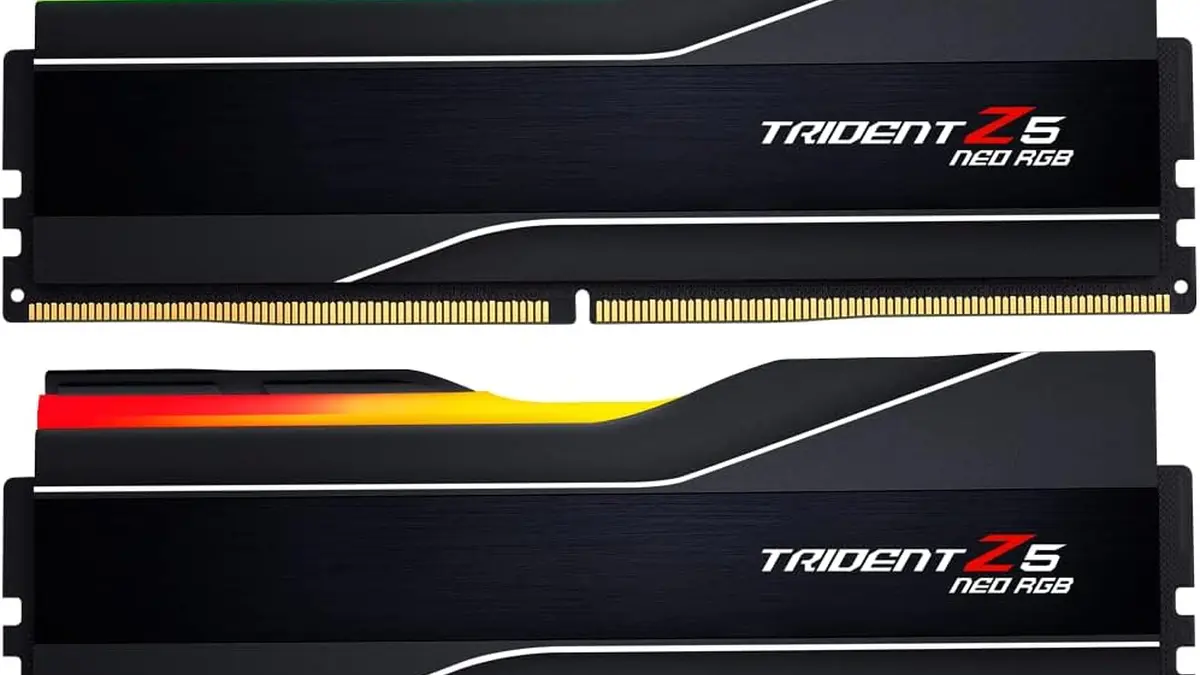
Buy the G.Skill Trident Z5 Neo RGB Series DDR5-6000 32GB CL30 if you want the EXPO profile to apply on the first POST and never think about memory again. Buy the Corsair Vengeance RGB DDR5-6000 32GB CL30 if you will tolerate a retry or two at the boot screen to keep $50, and if you are already running iCUE anyway.
That is the whole choice, because at DDR5-6000 CL30 with a 1:1 FCLK:MCLK ratio the two kits are doing the same job at the same clock with the same primary latency. What separates them, on the published record, is out-of-box behaviour and how much DRAM voltage each needs when you push past the rated profile.
The pricing context is the reason this matters more than it did a year ago. Newegg's own AM5 buying guide currently lists Corsair Vengeance DDR5-6000 CL30 at $519.99 and calls it "the play-it-safe choice", with a V-COLOR Manta XSky RGB kit at $419.99 as the value pick. For scale, a 2026 EXPO roundup still lists Kingston FURY Beast DDR5-5600 CL36 at under $80 per 32GB. A kit that needs an afternoon of manual tuning to reach its own sticker was an annoyance when 32GB cost $130. At $550 and up it is a defect you paid for.

G.SKILL Trident Z5 Neo RGB Series DDR5 RAM (AMD EXPO) 32GB (2x16GB) …
How the two kits line up
| Specification | G.Skill Trident Z5 Neo RGB DDR5-6000 32GB CL30 | Corsair Vengeance RGB DDR5-6000 32GB CL30 |
|---|---|---|
| Capacity and speed | 32GB (2x16GB), 6000 MT/s | 32GB (2x16GB), 6000 MT/s |
| Rated primary timings | CL30-38-38-96 | CL30, rated 16.7 ns |
| Default profile voltage (Gaming PC Guru) | 1.40V | 1.35V |
| One-click profile standard | AMD EXPO, native | AMD EXPO, one-click in AM5 BIOS |
| First-attempt EXPO POST, 4 boards (Gaming PC Guru) | 4 of 4 boards booted at rated profile on first attempt | Multiple POST retries on some of the same boards |
| Manual tuning result (Gaming PC Guru) | CL26-36-36-86 at 1.45V | 1.48V+ needed to approach comparable timings |
| Stated memory ICs (Gaming PC Guru) | Binning credited to AMD EXPO launch-partner validation | SK Hynix A-die |
| Amazon price, 16 September 2026 | $599.99 | $549.99 |
| Amazon rating | 4.8 / 5 from 1,621 reviews | 4.7 / 5 from 4,314 reviews |
Two caveats on that table before anyone quotes it. The boot data and the tuning voltages come from a single enthusiast blog, Gaming PC Guru, not from a lab that publishes its methodology, its sample count or its BIOS revisions. It is the only head-to-head on record for these two kits, which is a statement about the state of DDR5 coverage rather than an endorsement of the numbers.
The sources also disagree with each other. Gaming PC Guru's Corsair versus G.Skill comparison describes the comparable Corsair kit as running looser CL32 timings and gives G.Skill roughly a 6 percent true-latency edge on that basis, while the same site's standalone Corsair review tests a CL30 part at 1.35V. Fuhrmann Management lists the G.Skill CL30 kit at 1.35V, not 1.40V. Corsair and G.Skill both ship several DDR5-6000 SKUs under the same product name, so the practical lesson is to read the part number on the listing, not the family name in the review headline.
G.Skill Trident Z5 Neo RGB Series DDR5-6000 32GB CL30
The case for the G.Skill kit is entirely about first POST. Gaming PC Guru put it on an ASUS ROG Strix X870E-E, an MSI MPG Z890 Edge Ti, a Gigabyte Aorus Z890 Master and an ASRock X870E Taichi, and reports that "DDR5-6000 CL30 booted at advertised speed on all four AMD boards on the first attempt". The same writeup calls Trident Z5 Neo "the industry reference kit for AM5" and credits G.Skill's position as an AMD EXPO launch partner, which is a vendor-adjacent explanation but a plausible one: EXPO profile validation happens against AGESA microcode, and the vendors doing that work earliest tend to have profiles that survive contact with retail firmware.
Fuhrmann Management's EXPO roundup ranks the CL30-38-38-96 variant first overall and reports zero errors after a 48-hour stress run, the only sustained-endurance figure published for either kit here. Headroom looks real too: tuned samples reached CL26-36-36-86 at 1.45V, which is a full four clocks off the rated CAS latency at a voltage most AM5 boards will hold without drama.
The cost is $599.99 on Amazon, $50 over the Corsair, with a rating of 4.8 out of 5 across 1,621 reviews. Note that G.Skill's DDR5-6400 EXPO variant of the same family, ranked separately as the highest validated EXPO speed in a retail kit, runs async FCLK on most CPUs, so it trades the 1:1 ratio for bandwidth. If you are buying Trident Z5 Neo for AM5, buy the 6000 CL30 part, not the faster one.
This is the kit for the person who enables EXPO once, runs a memory test overnight, and wants that to be the end of it.
Corsair Vengeance RGB DDR5-6000 32GB CL30
Corsair's kit is not a compromise part, whatever the boot-retry data implies. Gaming PC Guru's standalone review puts it on SK Hynix A-die, calls the ICs "proven reliable across millions of units", states that "EXPO profiles enable one-click activation in AM5 BIOS; zero manual tuning required" and that "silicon lottery failure is rare" at the default 1.35V. Measured results on AM5: 73 to 75 ns AIDA64 latency, 105 to 110 GB/s sequential read, 100 to 105 GB/s write, 384 GB/s bandwidth, and 280 to 320 FPS in Counter-Strike 2 at 1440p. Those are the numbers a DDR5-6000 CL30 kit at a 1:1 ratio is supposed to produce, and it produces them.
The two marks against it are both from the comparative testing. The Corsair EXPO profile needed multiple POST attempts on some of the four boards that the G.Skill kit cleared first time, and tightening timings manually took 1.48V or more where G.Skill wanted 1.45V, which the same author reads as weaker binning. Separately, Fuhrmann Management's guide flags reported compatibility problems with a Corsair DDR5-6400 CL36 kit on specific ASUS X670E boards paired with a Ryzen 9 7900X, a different SKU but a reminder that Corsair's EXPO profiles are validated per part, not per family.
At $549.99 on Amazon and 4.7 out of 5 across 4,314 reviews, this is the largest review base of any kit in this comparison, and the low-profile heat spreader is genuinely useful under a tower cooler. Buy it if you want to spend $50 less, already run iCUE, or need the clearance, and you are not bothered by a retrain cycle at the boot screen.

Kingston Fury Renegade, and why it is not in the table
Nothing published covers Kingston Fury Renegade DDR5-6000 CL30 on AM5. Newegg's buying guide omits Kingston entirely, Gaming PC Guru's EXPO roundup substitutes Fury Beast, and Fuhrmann Management's twelve-kit ranking does the same. The closest data point is Fury Beast 32GB CL30 at 1.35V, ranked eighth and described as a solid runner-up running around 43 degrees Celsius under load, with a warning that Kingston's EXPO II profile "may have compatibility issues on some boards" where EXPO I is more broadly compatible. That is a different product line, and it is not evidence about Renegade. Until someone publishes a boot test on it, it does not belong in a ranking that turns on whether a profile applies cleanly.
Where the real gap is
Out-of-box profile behaviour, not performance. Both kits land on the same speed and the same primary latency at the same 1:1 ratio, and Newegg's guide explains why that combination is the target: "DDR5-6000 is the highest speed where that ratio holds reliably on virtually every CPU", with anything faster forcing an async ratio that gives back in latency what it gains in bandwidth. Once both kits are running their rated profile, the gap between them is noise. The 6 percent true-latency advantage cited for G.Skill is measured against a CL32 Corsair kit, not the CL30 part reviewed here, and should not be read as a performance gap between these two SKUs.
Voltage headroom. 1.45V versus 1.48V-plus for comparable tuned timings is a small number with a real consequence: it tells you which kit has slack left when the platform gets less forgiving, and the platform is currently getting less forgiving. If you want to buy headroom rather than tune for it, note what that costs at the top of the market, where EXPO Ultra Low Latency kits list at $1,099.99 for DDR5-6000 CL26.
The firmware is moving under both of them. ASUS pushed an AM5 beta BIOS wave built on AGESA ComboAM5 PI_Pre1.3.0.0 that adds a Bank Refresh Mode control with Normal, Fine Granularity and Mixed options, the last combining all-bank and same-bank refresh using tRFC2 and tRFCsb together as AMD's mitigation for the Phoenix Rowhammer work, which achieved privilege escalation on production DDR5 in as little as 109 seconds. The relevant warning for anyone buying a CL30 kit: previously stable DDR5-6000 EXPO profiles can go unstable after the update because the controller now enforces timing values that were previously ignored. ASRock, meanwhile, shipped beta BIOS 4.07.AS01 on AGESA 1.3.0.0a to fix no-boot scenarios on AM5 boards including cases where a machine stops booting after months of working fine, with unspecified memory compatibility optimisations bundled in. Both vendors describe this as improved stability; what it means in practice is that any boot-test result is a snapshot of one firmware revision, and troubleshooting writeups this year have put DDR5 kits at 6000 MT/s and above at the centre of EXPO-triggered WHEA_UNCORRECTABLE_ERROR and CLOCK_WATCHDOG_TIMEOUT reports on Ryzen 9000. Flash the current BIOS before you conclude your new $550 kit is faulty.
Which one to buy
Buy the G.Skill Trident Z5 Neo RGB Series DDR5-6000 32GB CL30 at $599.99. It is the only one of the two with a published four-board first-attempt EXPO boot record and a published 48-hour zero-error stress run, and it reached CL26-36-36-86 at 1.45V for anyone who wants to go further. At current DDR5 pricing, $50 is under 10 percent of the purchase and it buys the outcome you are paying for: the rated timings, applied by the BIOS, on the first try.
Buy the Corsair Vengeance RGB DDR5-6000 32GB CL30 at $549.99 if you are building to a hard budget, if you are already in the iCUE ecosystem, or if cooler clearance is tight. It runs SK Hynix A-die at 1.35V, it posted 73 to 75 ns and 384 GB/s of bandwidth in the review data, and 4,314 Amazon reviews at 4.7 out of 5 is a broader base of owner reports than the G.Skill kit has. The documented penalty is POST retries on some boards before EXPO takes, which costs you thirty seconds once rather than an afternoon.
Whoever you buy from, check the part number for CL30 rather than CL32 before you click, and update the motherboard BIOS before you blame the DIMMs. Neither vendor controls AGESA, and this year AGESA has been the variable that decides whether a rated profile holds.
Both kits, and the other DDR5 kits we track, are in our memory table with the AIDA64 latency and gaming results Tom's Hardware and others published for each.
Comments
No comments yet. Be the first to comment!
Leave a Comment