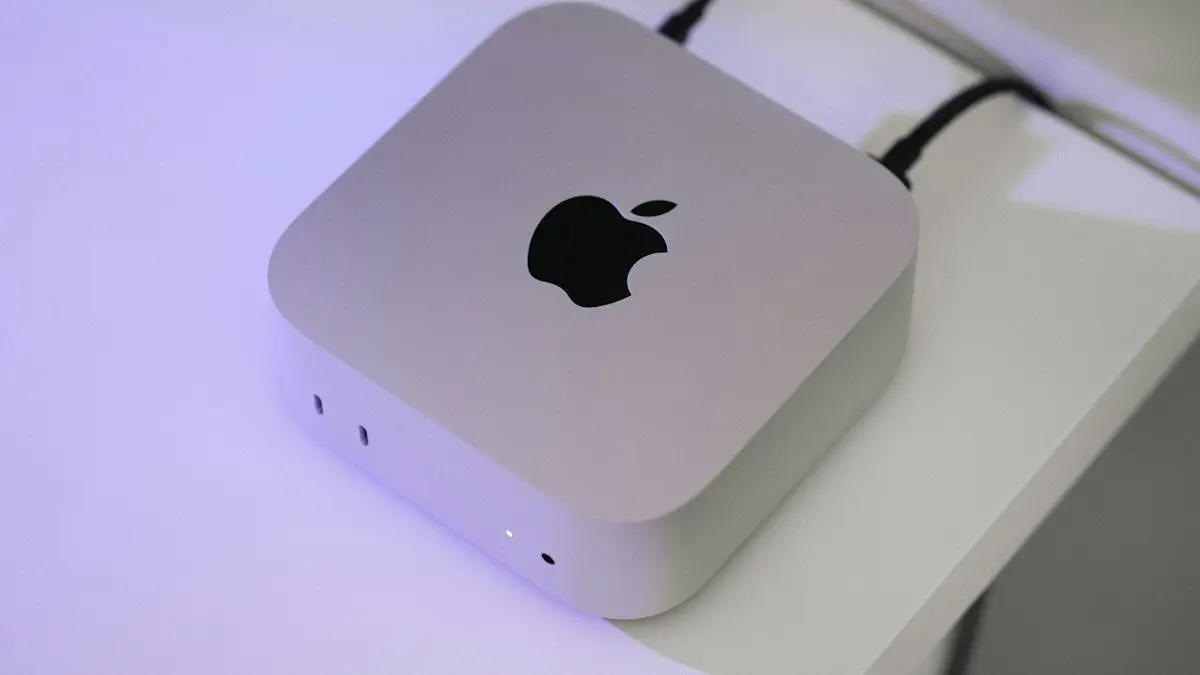
Apple shipped the Mac mini (M5 Pro, 2026) on September 22, 2026 at $1,699 for 24GB and 512GB. That is $300 more than the M4 Pro model it replaces cost. Reviews published since then put it about 13 percent ahead of the M4 Pro mini in single-core CPU work and 30 to 40 percent ahead in multi-core. The GPU gains are smaller and the AI gains smaller again, nowhere near the "4x" in Apple's pitch. For local language models, the 24GB base memory is where the plans stop working, not the chip.
The figures so far, in one table
Every row below comes from a single publication. Rows from different reviewers are listed separately and are not comparisons. The percentage column is each reviewer's own comparison with an M4 Pro Mac mini. The review units were not configured the same way: Fstoppers tested an 18-core CPU, 20-core GPU, 48GB machine, and gori.me tested the same chip with 24GB and 1TB. The Verge's figures went into the hub on September 21, 2026. Each of the other figures carries its date on the linked review.
| Test | Mac mini M5 Pro | Change vs M4 Pro mini | Source |
|---|---|---|---|
| Geekbench 6 CPU single-core | 4,294 | not given | The Verge, Sep 21, 2026 |
| Geekbench 6 CPU single-core (median of 4 runs) | 4,302 | +13.0% | Fstoppers |
| Geekbench 6 CPU multi-core | 29,104 | not given | The Verge, Sep 21, 2026 |
| Geekbench 6 CPU multi-core (median of 4 runs) | 29,137 | +30.6% | Fstoppers |
| Geekbench 7 single / multi-core | 3,727 / 33,992 | not given | Fstoppers |
| Geekbench 7 single / multi-core | 3,720 / 34,281 | not given | Macwelt |
| Geekbench 7 single / multi-core | not given | +12% / +38% | Macworld |
| Geekbench 7 GPU | not given | about +20% | Macworld |
| Geekbench 6 GPU Metal | 142,708 | not given | The Verge, Sep 21, 2026 |
| Geekbench Metal (early listing) | 141,000 | about +26% | Let's Data Science |
| Geekbench OpenCL (early listing) | about 87,155 | about +24.3% | Let's Data Science |
| Cinebench 2026 single / multi-core | not given | +11% / +40% | Macworld |
| Cinebench 2024 multi-core | 54,137 | not given | Macwelt |
| Blackmagic Disk Speed, 1TB, write / read | 11,956.1 / 12,231.0 MB/s | M4 Pro 2TB: 6,724 / 5,427 MB/s | Fstoppers |
| Internal SSD, 1TB, write / read | 10,220.4 / 11,253.6 MB/s | not given | gori.me |
| HandBrake 4K to 1080p H.265, x265 (CPU) | not given | 26% faster | Macworld |
| HandBrake 4K to 1080p H.265, VideoToolbox | not given | 41% less time | Macworld |
| ffmpeg ProRes 422 HQ 4K transcode | 21.7 s (8.0x realtime) | not given | Fstoppers |
| ffmpeg H.265 / H.264 transcode | 73.5 s / 70.7 s | not given | Fstoppers |
| Borderlands 3, 4K High | not given | +52% | Macworld |
| Total War: Warhammer III, 4K Ultra | 26 fps | not given | Macwelt |
| Rise of the Tomb Raider | 153 fps | not given | Macwelt |
| Ollama qwen2.5 7B / 14B / 32B (24GB unit) | 56.10 / 29.74 / 1.85 tokens/s | not given | gori.me |
| Draw Things, FLUX.1 schnell | 44.99 s | not given | gori.me |
On the CPU, the reviews agree. Fstoppers reports run-to-run variance of 0.28 percent single-core and 0.52 percent multi-core, which is as steady as Geekbench results get. The chip went from 14 cores to 18: per Macworld, that is 6 "super" and 12 performance cores, against the M4 Pro's 10 performance and 4 efficiency cores. That explains a 38 to 40 percent multi-core gain from a 12 percent single-core one. The GPU stays at 20 cores, so the 20 to 26 percent GPU gain comes from architecture and roughly 12 percent more memory bandwidth, not from more GPU cores. One awkward detail: Tom's Hardware measured the $899 Mac mini M6 about 21 percent faster than the M4 Pro mini in single-core Geekbench, which is a bigger gain than any reviewer found for the M5 Pro.
Apple's 4x, and the 10 to 33 percent the benchmarks found
Fstoppers reports that Apple claims up to 4x faster LLM prompt processing in LM Studio than the M4 Pro mini. Fstoppers did not test that claim, and none of the other sources here did either. Tom's Hardware looked at the M6's matching 4.8x claim and found it rests on a single time-to-first-token test: a 14B model at 4-bit precision in LM Studio. Prompt processing is the compute-heavy part of inference. It is also the part the Neural Accelerators Apple now builds into every GPU core are meant to speed up. Token generation, the speed you actually watch on screen, depends far more on memory bandwidth, and Macworld puts that only about 12 percent above the M4 Pro.
The general-purpose AI figures match that picture. Notebookcheck's early Geekbench AI listings show the M5 Pro about 20 percent ahead of the M4 Pro on GPU single precision, about 15 percent ahead on Neural Engine half precision and about 10 percent ahead on quantized. Macworld measured about 33 percent on the Neural Engine in low-precision formats. Notebookcheck did not publish raw M4 Pro scores.
| Geekbench AI (Notebookcheck, early listings) | Single precision | Half precision | Quantized |
|---|---|---|---|
| M5 Pro Neural Engine | 5,000 | 44,000 | 57,500 |
| M5 Max Neural Engine | 5,100 | 44,000 | 58,000 |
| M5 Pro GPU | 20,200 | 35,000 | 34,000 |
| M5 Max GPU | 27,000 | 43,100 | 41,000 |
| M4 Pro | not published | not published | not published |
The M5 Pro and M5 Max Neural Engine scores are effectively identical because, according to Notebookcheck, every M5 variant has the same 16-core Neural Engine. Notebookcheck also suggests that Geekbench AI may not yet use the per-core Neural Accelerators, and that macOS no longer optimizes OpenCL. That is the outlet's guess, not a finding. Checking Apple's 4x would take something simple that nobody among these sources has published: the same model at the same quantization in LM Studio on both minis, timing prompt processing and generation separately.
For the numbers a buyer will actually feel, gori.me measured 56.10 tokens a second on a 7B qwen2.5 model and 29.74 on 14B through Ollama. A 32B model dropped to 1.85 tokens a second, because it filled 22.81GB of the 24GB and swapped 5.40GB to the SSD. The same outlet timed FLUX.1 schnell in Draw Things at 44.99 seconds per image, against 37.89 seconds for an M4 Max MacBook Pro. Expert Reviews found the M5 Pro only slightly ahead of a two-year-old laptop with a mobile RTX 4070 in text generation.
Games, and a laptop GPU for comparison
Macworld measured a 52 percent gain in Borderlands 3 at 4K High, its largest gaming gain, and still called it not smooth at 4K. Macwelt measured 26 fps in Total War: Warhammer III at 4K Ultra and 153 fps in Rise of the Tomb Raider. Macwelt did not give settings for Rise of the Tomb Raider in the material we have. In early listings, Let's Data Science found the RTX 5060 Laptop GPU about 13 percent ahead of the M5 Pro in OpenCL, and noted that "API differences limit direct cross-platform comparisons." No source has an RTX 5070 laptop figure to set against it.
No publication has measured the M5 Pro mini in Cyberpunk 2077 or Counter-Strike 2. Until one does, there is no frame rate to put next to the RTX 5060 desktop card's 70.7 fps in Cyberpunk 2077 at 1080p Ultra (Tom's Hardware, June 24, 2026), and no price per frame to work out.
Disks, encoders and heat
Fstoppers' 1TB unit wrote at roughly 2x and read at roughly 2.3x the speed of the 2TB M4 Pro mini it compared against. That is a large jump for a drive half the size. Macwelt measured 4TB drives at up to 13,000 MB/s read and 12,000 MB/s write. No source has measured the base 512GB drive, which is the one the $1,699 price buys. The storage is soldered to the board, so the speed you get on day one is the speed you keep.
On video, the hardware encoder improved more than the CPU did: in Macworld's HandBrake test, VideoToolbox took 41 percent less time while x265 on the CPU ran 26 percent faster. Macwelt found almost no difference in HandBrake between machines with 20 and 36 CPU cores. gori.me exported a 10-minute DaVinci Resolve H.265 timeline in 3:08.28. That beat an M3 Max (3:21) and lost to an M5 Max (1:49).
Sustained load is mostly untested. Tom's Hardware ran ten Cinebench 2026 multi-core passes: 5,403 on the first run, 5,557 on the second, then 5,530 to 5,554 for the remaining eight. That shows no throttling. However, its review covers both the M6 and M5 Pro, and the material we have does not say which machine produced that run. No source has published noise figures. Macwelt's Stephan Wiesend draws the line clearly: "Der Mac Studio ist dagegen auf Dauerleistung ausgelegt" (the Mac Studio, by contrast, is built for sustained performance). gori.me found one point in the mini's favor. It finished a 100-file Photoshop AI denoise in 7:46, against 11:03 for an M5 Max MacBook Pro, which the outlet attributes partly to the desktop's better cooling.
Why the price went up
The whole lineup got more expensive, not just this model. Macworld lists the M6 mini at $899, up from the M4's $599, and the M5 Pro's $1,699 base against $1,399 for the same M4 Pro configuration. Macworld's review unit had the full chip (+$200), 48GB (+$600), 1TB (+$300) and 10GbE (+$100), for $2,899. The same specification on the M4 Pro cost $2,299. Tom's Hardware's headline says the mini is "losing its grip on value," and Expert Reviews' says "more power, more money."
This is a good computer at a bad price.
Is the Mac Studio M5 Max worth $800 more than this?
The side-by-side covers local model text generation, Blender and memory bandwidth for the two desktops.
Read Mac mini vs Mac StudioWhich configuration to buy, and which Mac instead
For CPU and video work, buy the base model, and not at Apple. When Macworld checked prices, B&H had it at $1,549, Walmart at $1,627, and Apple and Best Buy at the full $1,699. Check the price on Amazon too. Education buyers pay $1,599 from Apple, according to Gadget Review.
For local LLMs, skip 24GB. gori.me puts the practical ceiling at 7B to 14B models. There is no 36GB option, so the next step up is 48GB, which Macworld prices at +$600. The Mac memory guide explains why the GPU gets less than the number on the box, and the LLM fit tool checks a specific model against a configuration.
For games, or for GPU-bound AI, this is the wrong Mac. According to Macwelt, the Mac Studio (M5 Max) has the same 18-core CPU but 40 GPU cores to the mini's 20, with 614 GB/s of memory bandwidth against 307. In Total War, that meant 44 fps against 26. Macworld prices a 36GB/1TB Studio at $2,799. The hub lists the 36GB/512GB model at $2,499.
The MacBook Pro 16-inch (M5 Pro) uses the same 18-core CPU and 20-core GPU and has cost $2,999 since June 25, 2026. Notebookcheck measured it at 4,295 single-core and 28,436 multi-core in Geekbench 6 (March 9, 2026). That is close to The Verge's figures for the mini, but they come from different reviewers on different benches. What the extra $1,300 buys is a screen and a battery. For light work, the $899 M6 mini is the one Tom's Hardware found faster per core.
Mac mini (M5 Pro, 2026)
- Geekbench 6 CPU Single-core 4,294 points The Verge, Sep 21, 2026
- Geekbench 6 CPU Multi-core 29,104 points The Verge, Sep 21, 2026
M5 Pro mini against the model it replaces and the Studio above it
| Mac mini M5 Pro | Mac mini M4 Pro | Mac Studio M5 Max | |
|---|---|---|---|
| Price | $1,699Apple US price, 15-core CPU, 16-core GPU, 24GB / 512GB | $1,399launch price, 12-core CPU, 16-core GPU, 24GB / 512GB | $2,499Apple US price, 32-core GPU, 36GB / 512GB |
| Chip | Apple M5 Pro | Apple M4 Pro | Apple M5 Max |
| CPU cores | 15 (5 super, 10 performance); 18 optional | 12 (8 performance, 4 efficiency); 14 optional | 18 (6 super, 12 performance) |
| GPU cores | 16 | 16 | 32 (40 optional) |
| Memory (base) | 24 GB | 24 GB | 36 GB |
| Geekbench 6 CPUSingle-core, points | 4,294 | n/a | 4,355† |
| Geekbench 6 CPUMulti-core, points | 29,104 | 22,661† | 30,384† |
| Geekbench 6 GPUMetal, points | 142,708 | n/a | 238,904† |
| Local LLM (llama.cpp / Ollama)tg128 Llama 2 7B Q4_0, tok/s | 67.6 | 49.6 | 120 |
| Local LLM (llama.cpp / Ollama)pp512 Llama 2 7B Q4_0, tok/s | 1,340 | 364 | 3,220 |
| Blender Benchmarksamples/min | 3,643 | 2,570 | 6,462 |
| Buy | Check price on AmazonCheck price at Best Buy | Check price on AmazonCheck price at Best Buy | Check price on AmazonCheck price at Best Buy |
Figures as published by Blender Open Data (Oct 19, 2026), Macworld (Sep 21, 2026), The Verge (Sep 21, 2026), Tom's Guide (Sep 21, 2026), llama.cpp community benchmarks (GitHub) (Oct 19, 2026). † From another publication than the rest of its row, so not a like-for-like test. The best figure is marked where a row is all one source.
Compare every benchmark side by sideStill unanswered
The sources disagree about what $1,699 gets you. The hub lists the base model with a 15-core CPU and 16-core GPU, and Macworld prices the full chip as a $200 option. Gadget Review lists the 18-core CPU and 20-core GPU at the $1,699 starting price. Every review unit above had the full chip, so no source has benchmarked the binned version. Also still missing: raw Geekbench AI scores for the M4 Pro, a speed test of the 512GB drive, noise measurements, an RTX 5070 laptop comparison, a Cyberpunk 2077 frame rate, and an independent check of Apple's 4x. The gaming results Tom's Hardware published (37.33 fps at 1440p and 58.11 fps at 1080p on the "For this Mac" preset) come without the game's name or the chip in the material we have, so this post does not use them. No source has November retailer prices; the ones above are from Macworld's review.
What to watch
No date has been announced for any of the following. Watch for a Geekbench AI update that uses the GPU Neural Accelerators, which would test Notebookcheck's theory. Watch for the first published LM Studio results that time prompt processing and generation separately on the M4 Pro and M5 Pro minis, which would test Apple's 4x. Watch whether B&H's $150 discount spreads to Best Buy, the price that decides whether the base model is worth buying now. The product page will add each new figure as it is published, with its source and date.
Comments
No comments yet. Be the first to comment!
Leave a Comment