The ROG Thor III EVO's 1600W rating is a 240V figure. On 100 to 120V mains it is a 1300W power supply, which Hardware Busters flagged on September 10 and which ASUS does not lead with anywhere in its marketing.
The reasoning is circuit compliance rather than silicon. crmaris put it bluntly: "A Titanium-class unit pushing 1,600 W out is drawing something close to 1,700 W in, and at 100 V that is roughly 17 A." Standard household circuits in Japan and North America stop at 15A. Run the arithmetic against measured efficiency instead of a round 94% assumption and it looks worse still: the base Thor III managed 89.55% at full load on 115V, which puts input at roughly 1,787W, about 14.9A at 120V and close to 18A at 100V. There is no room left in the breaker.
The awkward part is that Cybenetics already ran the previous Thor III to a full 1600W on a 115V input in August 2024 and published the efficiency and noise curve for it. The platform can do it. The EVO's label says it will not.
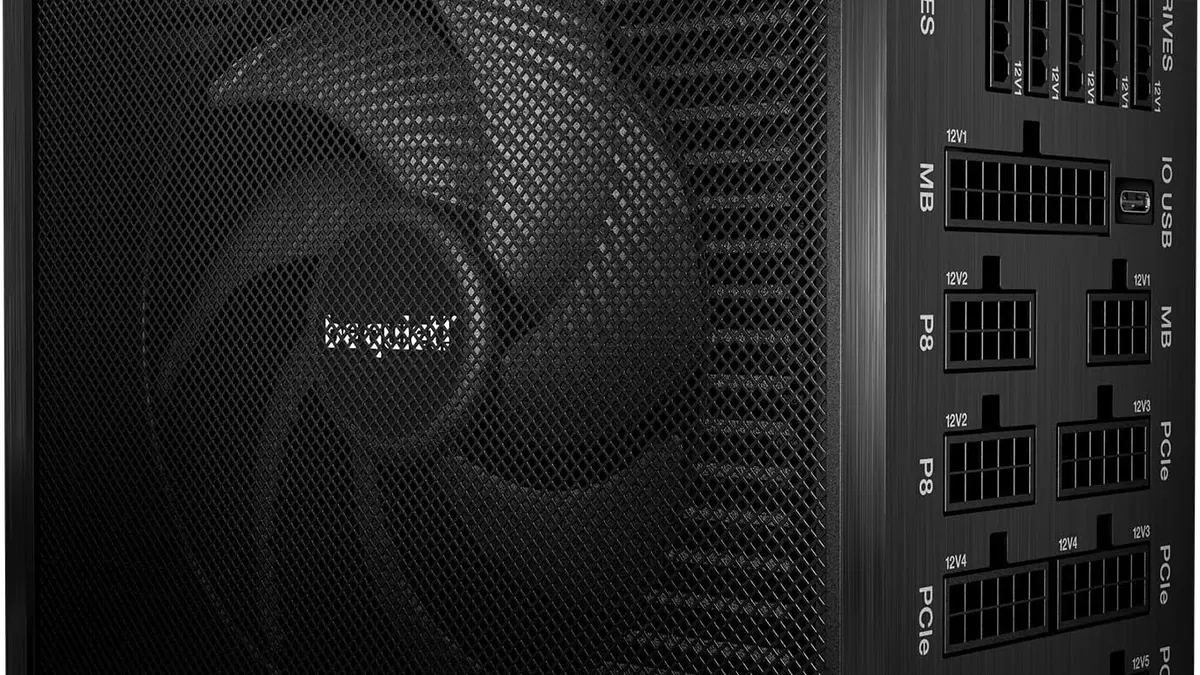
Meanwhile be quiet!'s Dark Power Pro 14 IO 1600W has a complete independent dataset at 115V, published in full on September 15, and no asterisk on its rating. That is the comparison: a verified 1600W against an unverified one that is contractually 1300W where most of this blog's readers live.
The numbers, side by side
| Spec | ASUS ROG Thor 1600W Titanium III EVO | be quiet! Dark Power Pro 14 IO 1600W |
|---|---|---|
| Rated output, 240V | 1,600W | 1,600W |
| Rated output, 100 to 120V | 1,300W (derated) | 1,600W |
| 115V average efficiency | 91.842% (base Titanium III, 2024 report) | 91.193% |
| 115V full-load efficiency | 89.55% (base model) | 89.235% |
| 230V average efficiency | 93.672% (base model) | 92.612% |
| 115V average noise | 18.23 dBA (base model) | 23.12 dBA, LAMBDA A |
| 115V full-load noise | 30.7 dBA at 1,052 RPM (base model) | 34.1 dBA at 1,566 RPM |
| Fan | 135mm, semi-passive (0dB below 20% load per ASUS, below 40% per launch coverage) | 135mm fluid dynamic bearing, semi-passive |
| Hold-up time | 23.8ms (base model) | 20.1ms |
| Standby draw at 115V | 0.0244W (base model) | 0.0139W |
| 12V-2x6 provision | Native connector plus proprietary ROG Equalizer cable, 17A per wire claimed | Two 600W 12V-2x6 PCIe 5.1 connectors |
| Monitoring | OLED display on magnetic extender | IO Center software, rail mode and fan mode switching |
| Warranty | 10 years | 10 years |
| Price on source date | approx. $864, Japanese retail (Sept 2026) | £449.99 / €479.90 (Club386, 1 Sept 2026) |
Every ASUS efficiency and noise figure in that table comes from the 2024 Cybenetics evaluation of the base ROG Thor 1600W Titanium III, report 24PS2523A. The EVO is a revision of that unit with changes concentrated in the GPU cable and the side-mounted OLED, so the platform numbers are a reasonable starting point, but they are not measurements of the product on sale. Hardware Busters was explicit about the state of play: "None of this has been measured independently yet."
Thor III EVO: paying a premium for a cable
What the EVO adds over the 2024 unit is the ROG Equalizer 12V-2x6 cable, which ASUS says lifts the per-wire current rating from 9.2A to 17A and spreads current more evenly across the pins, and a GPU-First Intelligent Voltage Stabilizer that samples voltage at the graphics card rather than at the motherboard. ASUS claims up to a 45% improvement in voltage stability at the 16-pin connector. Both are plausible engineering responses to the connector-melting genre of forum thread. Neither has been measured by anyone outside ASUS.
Verifying the first claim needs per-wire current logging on a loaded 12V-2x6 harness, ideally with a deliberately imperfect seat, which is precisely the test no vendor commissions. Verifying the second needs a scope on the GPU-side 12V during transient excursions, compared against a non-Equalizer cable on the same unit. Until someone does that, the 45% is a number from a slide.
The efficiency story is inherited and good: 91.842% average across more than 1,450 load combinations at 115V, with 94.246% at 20% load, which is where a gaming rig actually idles. Noise inherited from the base unit is better than the be quiet across the board, with a 18.23 dBA average and 30.7 dBA at full tilt. ASUS's product page claims a Cybenetics LAMBDA A+ acoustic rating. The Cybenetics evaluation of the platform includes the note "Fan speed profile is too loose to achieve LAMBDA-A+", which is a lab telling a vendor its fan curve is lazy, not quiet. The two statements cannot both be describing the same measurement.
There is also a small internal inconsistency worth noting: ASUS's own page puts 0dB fan-stop at or below 20% load, while launch coverage in August quoted 40%. On a 1600W chassis that is the difference between the fan waking at 320W and at 640W.
- Best measured acoustics in this pair, 18.23 dBA average and 30.7 dBA at full load on the base platform
- Highest measured 115V average efficiency of the two, 91.842%
- 23.8ms hold-up, the longer of the two
- Current-balancing 12V-2x6 cable is a real attempt at the connector problem, whatever the marketing arithmetic
- OLED power readout that does not need software running
- 1,300W on a standard 100 to 120V circuit, not 1,600W
- No independent test of the EVO revision exists as of September 2026
- LAMBDA A+ claim contradicted by Cybenetics' own note on the platform's fan curve
- Roughly $864 in Japan, nearly double the be quiet unit's European price
- GaN and IVS gains are vendor figures with no published third-party comparison
Dark Power Pro 14 IO: fully instrumented, slightly louder
be quiet!'s flagship is a digitally controlled CWT platform and the first of its PSUs with software control, via the IO Center application for real-time monitoring, rail-mode switching and fan-mode selection. Cybenetics certified it on 17 June 2026: 91.193% average at 115V, 92.612% at 230V, which lands it Titanium at US voltage and Platinum at European voltage. That inversion of the usual marketing order is unusual and worth sitting with, because it means the unit is tuned for the mains most of its buyers in this comparison are on.
Efficiency peaks at 40% load, 93.9% at 115V per Hardware Busters' September 15 review, and full load at 115V comes in at 89.235%, effectively tied with the ASUS platform's 89.55%. Power factor sits between 0.989 and 0.996 across the range at 115V. Standby draw is 0.0139W, among the lowest anyone has measured.
Noise is where it gives ground. The 23.12 dBA average at 115V earns LAMBDA A rather than A+, and full load pushes 34.1 dBA with the fan at 1,566 RPM. That is around 3.4 dB louder than the ASUS platform at the same point, which is audible rather than academic. The distribution matters more than the average, though: the fan stays under 6 dBA to roughly 900W and under 15 dBA to about 1,000W, with the entire noise story compressed into the last 250W of load. Club386's 230V sweep found the same shape, silent through 800W, then 1,084 RPM and 33.2 dBA at 75%, then 1,576 RPM and 36.8 dBA at full output, which the reviewer still called "a masterclass in modern power supply engineering".
Hold-up is 20.1ms, shorter than the ASUS platform's 23.8ms but not in a range that should worry anyone with a functional UPS or a stable grid. The compliance list is complete: ErP Lot 3/6, EU 617/2013, ATX v3.1 power excursion, EN 55032/CISPR 32.
- 1,600W is 1,600W on a 115V line, with a published certification to prove it
- Titanium at 115V and Platinum at 230V, unusually tuned toward US mains
- Silent below roughly 900W of load, which covers most real gaming sessions
- Two native 600W 12V-2x6 connectors
- IO Center allows single or multi-rail switching and fan profiles in software
- 0.0139W standby draw, lower than the ASUS platform
- 34.1 dBA at full load, the louder unit by a perceptible margin
- LAMBDA A, not A+
- 20.1ms hold-up, shorter than the Thor platform
- Monitoring depends on a Windows application rather than an onboard display
- 115V average efficiency trails the Thor platform by 0.65 points
What separates them once the labels come off
Efficiency is a tie in any way that matters. 91.842% against 91.193% at 115V is 0.65 percentage points, and at full load the gap closes to 0.3 points in the ASUS platform's favour. On a system pulling 800W for four hours a night, that difference does not buy you a coffee in a year. Anyone choosing between these on efficiency has been reading spec sheets rather than power bills.
Noise is a real gap, roughly 3.4 dB at full load and about 4.9 dBA on average. But both units are silent below 50% load, and the be quiet stays under 6 dBA to around 900W. If your build genuinely sustains over 1.35kW, that acoustic difference will show up. If it does not, you are comparing two fans that are switched off.
Capacity is the only difference with a hard edge. On a North American or Japanese outlet, one of these is a 1300W unit and the other is a 1600W unit, for roughly double the price in the derated direction. Everything else is a tiebreak.
The monitoring approaches split on trust. be quiet's rail monitoring and mode switching live in IO Center, so they stop when the application stops. ASUS's OLED runs off the PSU itself and reports draw whether or not Windows is cooperating. As voltage-stabilisation mechanisms, neither has been independently compared: the be quiet unit has full rail and ripple data from Cybenetics, while the EVO's GPU-First sampling has no third-party measurement at all. Ripple on the ASUS platform at 115V full load was 35.65mV on 12V, 18.81mV on 5V and 24.81mV on 3.3V, which is the base unit rather than the EVO and the only ripple figure in either public dataset.
Which one to buy
On a 100 to 120V circuit, buy the be quiet! Dark Power Pro 14 IO 1600W. It is the only one of the two that delivers the number on the box at your wall voltage, it has a complete independent certification for the exact SKU on sale, and at £449.99 / €479.90 as of September 1 it costs substantially less than the roughly $864 the EVO was fetching at Japanese retail. You pay for it with about 3.4 dB at full load, in a load band most builds never reach.
On 230V mains, the argument narrows considerably. The ASUS platform's 93.672% average and 17.89 dBA are both better than the be quiet's 92.612% and 22.60 dBA, the derating disappears, and the OLED plus current-balancing cable start to look like reasons rather than consolations. It is still a large amount of money for a revision whose headline improvements nobody outside ASUS has measured.
The third answer is the one neither vendor wants: if you are on a 120V circuit and the ASUS is going to give you 1300W anyway, look at be quiet's 1300W Dark Power Pro 14 IO, certified the same day. It posts 91.819% average efficiency at 115V, essentially matching the 1600W unit, and does it at 15.47 dBA average against 23.12 dBA, with 30.3 dBA at full load and 32.9 dBA at 110% overload. Same delivered wattage as a derated EVO, quieter than either 1600W unit, and one fewer asterisk on the carton.
We will revisit this when Cybenetics publishes an EVO evaluation. If the GaN switching and the revised cable do what ASUS says, the numbers will show it, and the LAMBDA A+ claim will either be confirmed or join the fan curve note in the file marked unresolved.

Comments
No comments yet. Be the first to comment!
Leave a Comment