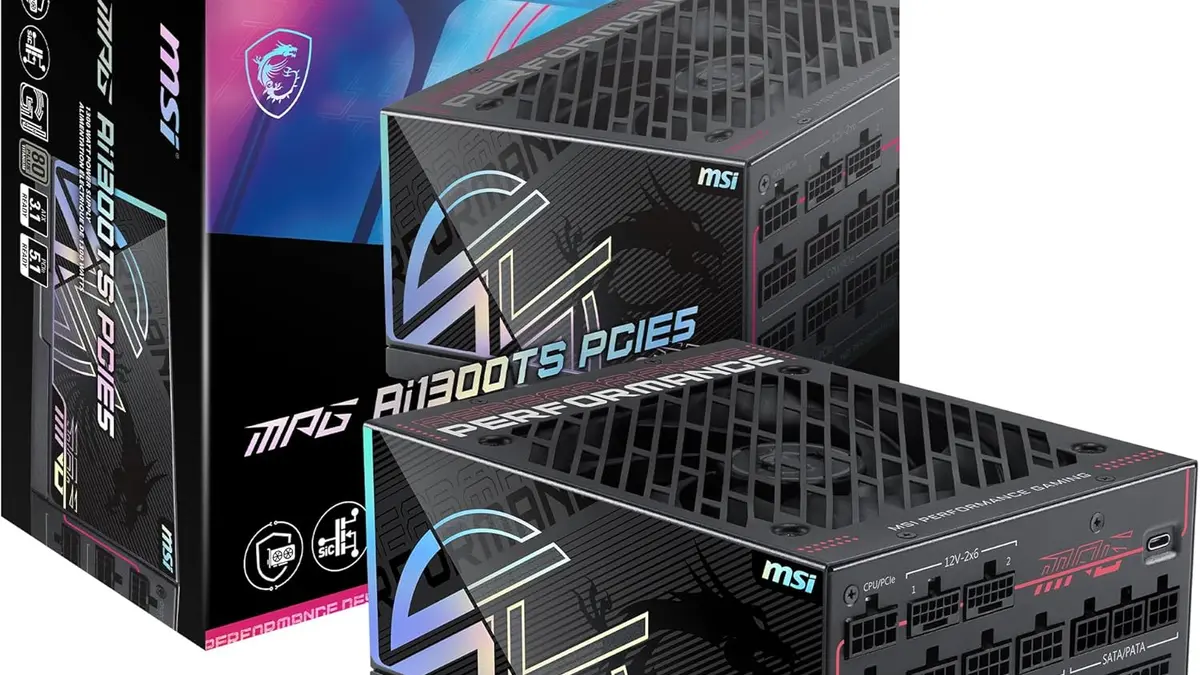
The three headline 12V-2x6 protection schemes on sale right now do not measure the same variable, do not trip at the same point, and in one case do not trip at all. That distinction matters more than any league table, because a safety system watching the wrong quantity is not slow. It is absent.
MSI's GPU Safeguard+ watches per-pin current. Gigabyte's T-Guard watches cable temperature. ASUS's ROG Equalizer watches nothing, because it is a passive cable that tries to prevent the imbalance rather than react to it. Corsair's ThermalProtect, which we have covered separately, sits in the same thermal camp as T-Guard but with a threshold roughly 45°C lower.
The honest starting point is that nobody has run all three against the same fault. The public numbers come from four labs using four different fault models: Corsair's own 60°C-ambient rig with a deliberate 3mm connector gap, Hardware Busters driving six programmable Array loads at 26°C ambient, ASUS's marketing test with four of six conductors severed at 55°C ambient, and a repair bench in Europe where a $15,000 card's connector melted anyway. Those results are not interchangeable, and the vendors benefit from readers treating them as though they are.

GIGABYTE Gaming 1000GM PG5 ATX 3.1 & PCIe 5.1 Ready Fully Modular …


The three schemes side by side
| MSI GPU Safeguard+ | Gigabyte T-Guard | ASUS ROG Equalizer | |
|---|---|---|---|
| Detects | Per-pin current: imbalance across the six pins, plus sustained overcurrent on any one pin | Cable temperature via embedded thermistor | Nothing. Passive current redistribution |
| Sensor location | Smart IC inside the PSU | Inside the 12V-2x6 cable | Internal bridges ~3cm from each connector |
| What stops | GPU throttled to ~75% power limit on NVIDIA, ~25% on AMD; PSU buzzer sounds | GPU power limit cut by an undisclosed amount; rest of PC stays up | Nothing stops |
| Ships on | MPG Ai TS series PSUs | Gaming 1000GM PG5, 850GM PG5, 750GM PG5 | ROG Thor III and ROG Strix Platinum PSUs; $49 standalone |
MSI GPU Safeguard+: the only one watching current
A smart IC in the PSU reads current independently on all six +12V conductors and looks for two conditions: imbalance between pins, and current on a single pin sustained past a time limit. On a trigger it sounds a buzzer from the PSU itself, which works with no software running, and pushes a pop-up through MSI Center or Afterburner. The throttle drops the card to roughly 75% of its power limit on NVIDIA hardware. On AMD it drops to roughly 25%, a number MSI has not explained and which reads less like a tuned response than a fallback profile someone found lying around.
Current sensing is the right variable, and the reason is geometry. Current in a conductor is the same at both ends of it. A high-resistance contact at the GPU socket shows up as reduced current on that pin measured at the PSU, immediately, before any copper has had time to heat. Thermal schemes only see a fault once enough heat has accumulated at the specific point where they put the sensor, which is exactly the failure mode that took out an ASRock Taichi TC-1650T this month.
The catch is that MSI has not told you where the line is. The abnormal-current thresholds are user-configurable ranges inside Afterburner 4.6.7 or newer, which means the out-of-box behaviour is undefined in public and the full feature set is gated behind a software install. Compare ASUS's GPU-side Power Detector+, which at least publishes its numbers: a 9.2A soft warning matching the PCI-SIG per-pin floor, and a hard 12.5A shutdown trigger you cannot adjust. MSI has also not published a time-to-action figure, and neither has anyone testing the units independently.
T-Guard sets its alarm above the fire
Gigabyte's approach is the cleanest to describe: a thermistor inside the 12V-2x6 cable, protection logic inside the PSU, no driver, no monitoring app, no cooperation from the GPU vendor. When the sensor reads above threshold the PSU cuts the GPU's power limit rather than killing the system, so the rest of the machine stays up and you can save your work. It ships on the 1000GM PG5, 850GM PG5 and 750GM PG5, all Cybenetics ETA Platinum and LAMBDA A+, sub-20dBA average on a 135mm FDB fan, Japanese capacitors, ten-year warranty, and colour-coded pins so you can see the plug is home.
Those are good power supplies. The protection feature is the weak part.
Gigabyte has never officially published the trip point. Reporting and teardown analysis put it around 110°C, possibly as high as 115°C. Now hold that against the measurements. A well-seated connector at full load runs 60°C to 80°C. Hardware Busters' deliberately abusive fault, three pins at 17A and three at 1A held for ten minutes, peaked at 93.6°C on the hot group and stabilised there rather than running away. On that bench, at 26°C ambient, T-Guard never fires. Ambient inside a case is higher and a real fault can be worse than a clean 17A/1A split, so it is not a useless threshold. It is a threshold set to catch a fire, not to prevent one.
Gigabyte also has not disclosed how far the power limit drops when it does trigger, which is the number that determines whether the protection event is a brief stutter or a card running at a third of its performance until you reboot.
ROG Equalizer, and the 73.4°C that keeps getting misattributed
The Equalizer is not a detector and should not be compared to the other two as though it were. Its receptacles are gold-plated and rated to 17A per pin against the 9.2A spec floor, but the HWCooling teardown update of 11 May 2026 found the real mechanism is a pair of internal bridges about 3cm behind each connector that tie the six conductors together and let current redistribute. That is also why the cable is stiff enough to worry about the mechanical load it puts on the GPU receptacle, which is itself a documented failure point.
One number needs correcting because it has been repeated as though it were independent. The 146°C versus 73.4°C comparison is ASUS's own fault-injection test: four of six +12V wires deliberately disconnected, 25A forced through the remaining two, 55°C ambient. It is not a Hardware Busters result. What Hardware Busters actually measured, using six programmable loads to set per-pin current electronically rather than cutting wires, was 93.6°C on the three pins carrying 17A and 69.7°C on the three carrying 1A, over ten minutes at 26°C ambient and 45% RH. Stable, survivable, and about 20°C warmer than the figure ASUS's marketing put in circulation.
The balancing itself measures inconsistently. der8auer found up to 4A of spread between highest and lowest pin with the bridge installed, and about 1.5A with it removed, which is not the direction ASUS would have chosen. igor'sLAB, reversing the same cable to rule out unit variance, measured 1.98A of spread with the balancing block at the GPU end and 0.72A with the block toward the PSU, then called the design "technically interesting and exceptionally robust". Both things can be true: the cable is well built and its orientation matters more than the box admits.
And the viral "87.5% improvement" figure traces back to one Reddit user comparing a worn 12VHPWR cable at 11.2V against a new Equalizer at 11.9V, published by Wccftech on 4 August 2026. A degraded cable is not a baseline.
If you want a trip point from ASUS you need a supported card and GPU Tweak III 2.1.8.0, where auto-shutdown fires at 12.5A on any single wire, rising to 18A if the Equalizer is fitted. It ships disabled by default, with a five-minute warning delay and a one-minute shutdown countdown, and it kills the whole machine rather than throttling.
What the comparison actually turns on
Three things separate these designs, and price is not one of them.
Variable. Current leads temperature. An imbalance is detectable the instant it exists; heat needs time and a sensor in the right place. That is one point to MSI and, in a different way, to ASUS for attacking the imbalance directly.
Threshold versus normal operation. T-Guard's estimated 110°C sits above a measured worst-case fault. Corsair's ThermalProtect trips at 65°C ±5°C, which sits inside the normal 60°C to 80°C operating band, which is precisely why Corsair built in a 600W to 150W step-down and an automatic reset instead of a shutdown. Neither vendor found a threshold that is both safely low and free of nuisance trips, because there may not be one.
Sensor placement. The ASRock case reported this month is the cautionary tale for every thermal scheme here. A 600W RTX PRO 6000 on a 1650W Taichi TC-1650T melted at the PSU-side modular socket with both ends confirmed fully seated. TempGuard has an NTC sensor and a 105°C shutdown trigger, and it did not fire, reportedly because the sensor sits on the ground-side line and at the wrong end of the cable. Corsair's bimetallic switch is 30mm from the GPU connector. Gigabyte has not said where in the cable its thermistor lives. In Corsair's own 3mm-gap test at 60°C ambient, connector temperature exceeded 115°C before the switch opened in under one minute twenty seconds. That is what thermal protection buys: a limit on how long the fault runs, not a guarantee the plastic stays intact.
Which one to buy
Buying a new PSU for a 600W-class card: MSI's MPG Ai TS series. Per-pin current monitoring is the only approach that sees the fault at the moment it starts and sees it regardless of which end of the cable is going bad. Accept that you will install Afterburner 4.6.7 or newer and set your own threshold, because MSI has not published one for you.
Buying a 750W to 1000W PSU for a mid-range build: the Gigabyte PG5 units are genuinely good, and worth the money on efficiency, noise and the ten-year warranty. Do not buy them for T-Guard. An undisclosed trip point estimated above the temperature a measured unbalanced fault actually reaches is a marketing line more than a safeguard.
Already own a PSU: you are shopping for a cable or an adapter, and the Equalizer at $49 is a reasonable buy for worst-case thermal margin as long as you understand it detects nothing and you route it carefully given the stiffness. If you want an actual cutoff without a new PSU, Corsair's ThermalProtect cable works on any native 12V-2x6 port with no software, and Cooler Master's GPU Shield inline adapter does per-pin current monitoring with an LED seating indicator and an audible alarm for $49.99, though the warranty outside China drops to one year.
None of this makes the connector safe. A Gigabyte Aorus Master Ice RTX 5090 melted its connector at a 500W cap and a 0.9V limit, 100W and 0.205V below stock. Undervolting is not a mitigation, and neither, on current evidence, is a thermistor set to 110°C.
The cards that need these cables draw a lot: Nvidia rates board power at 360W for the RTX 5080 and 575W for the RTX 5090. Every current graphics card is listed with its rated power and the connector it uses.
Comments
No comments yet. Be the first to comment!
Leave a Comment