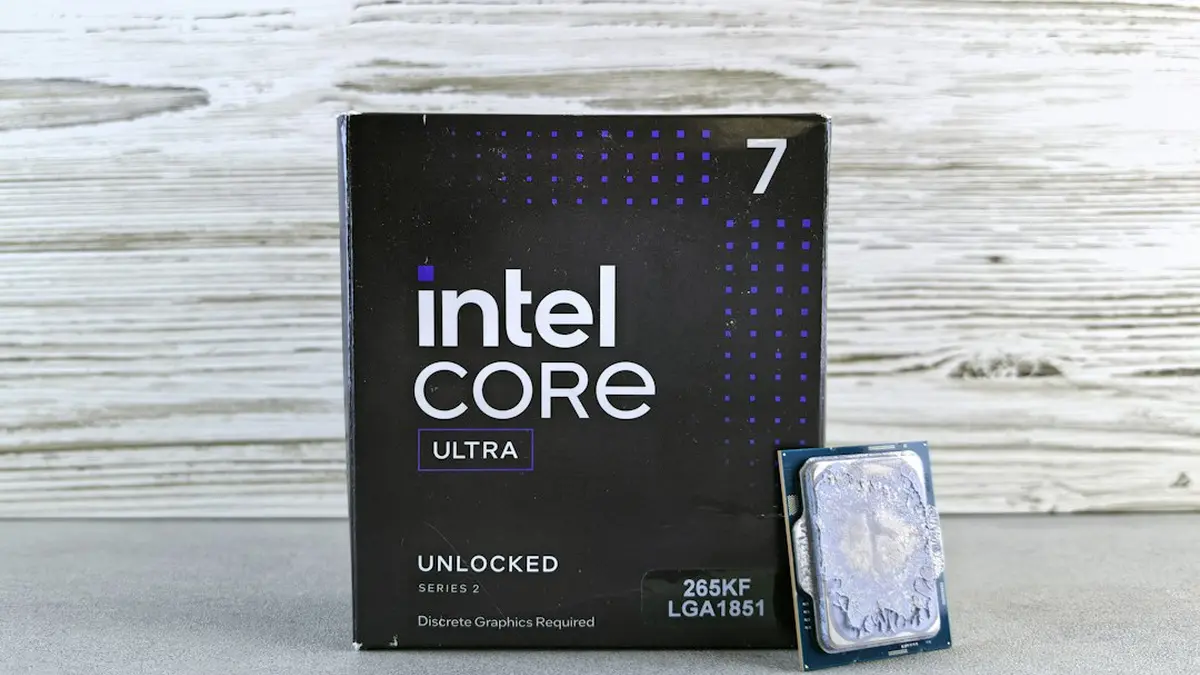
The Core Ultra 7 270K Plus is faster than the Core Ultra 5 245K at everything anyone has published. That means roughly 17 to 20 percent more frames at 1080p and 59 to 92 percent more multithreaded throughput. On PassMark's November 22, 2026 price list it costs $108.88 more ($288.87 against $179.99). For a gaming build where the GPU should get every spare dollar, buy the 245K. For a machine that also renders, encodes or edits video, buy the 270K Plus: for that work, the extra money buys at least as much performance per dollar as the 245K gives.
Spec sheet and published results
| Intel Core Ultra 5 245K | Intel Core Ultra 7 270K Plus | |
|---|---|---|
| Released | Oct 24, 2024 | Mar 23, 2026 (retail from Mar 26) |
| Launch price | $309 | $300 (Intel MSRP $299) |
| Price listed by PassMark, Nov 22, 2026 | $179.99 | $288.87 |
| Cores (P + E) / threads | 6P + 8E, 14 threads | 8P + 16E, 24 threads |
| P-core base / boost | 4.2 / 5.2 GHz | 3.7 / 5.5 GHz |
| L2 / L3 cache, PassMark | 26MB / 24MB | 40MB / 36MB |
| Socket | LGA1851 | LGA1851 |
| Rated TDP | 125W | 125W |
| Max power draw, EatYourBytes | 159W | 250W |
| Integrated GPU, EatYourBytes | Xe-LPG, 64 EU, 1,900 MHz | Xe-LPG, 64 EU, 2,000 MHz |
| PassMark CPU Mark (multi), Nov 22, 2026 | 42,988 | 68,492 |
| PassMark single-thread, Nov 22, 2026 | 4,711 | 5,073 |
| Cinebench 2024 multi-core, Tom's Hardware | 1,488 (Mar 23, 2026) | 2,509 (Apr 21, 2026) |
| Blender Benchmark samples/min, Blender Open Data, Oct 19, 2026 | 318 | 611 |
| Counter-Strike 2 1080p Ultra, Tom's Hardware | 524 fps (Mar 23, 2026) | 663 fps (Apr 21, 2026) |
| Cyberpunk 2077 1080p Ultra, Tom's Hardware | 101 fps (Mar 23, 2026) | 116 fps (Apr 21, 2026) |
| 14-game avg 1080p Medium (1% low), DropReference, RTX 5090 | 172 (130) fps | 206 (157) fps |
| 14-game avg 1080p Ultra (1% low), DropReference, RTX 5090 | 145 (109) fps | 169 (130) fps |
| Gaming index out of 100, HowManyFPS | 60 | 69 |
Two caveats on the rows. The Tom's Hardware figures for the two chips come from two different reviews: the 245K's from the 270K Plus review of March 23, and the 270K Plus's from the Ryzen 9 9950X3D2 review a month later. Same publication, separate runs, so read the gap as a guide, not a measurement. The DropReference, PassMark and Blender Open Data rows put both chips through the same test.
Some things are missing from the sheet because the sources don't have them. None of them gives the 245K's memory spec or either chip's NPU TOPS, and none lists H810 support. Nobody has published LLM tokens a second or images a minute for either CPU running on its own. The other pages ranking for this comparison guess at those numbers. This one doesn't.
Intel Core Ultra 5 245K
The Core Ultra 5 245K launched on October 24, 2024 at $309. Nobody pays that now. Wccftech logged it at $190 at Newegg during the Holiday 2025 promotion, after a $40 coupon off $229, with a free 240mm AIO thrown in. Tom's Hardware later reported its lowest price ever; check the price on Amazon. PassMark listed it at $179.99 on November 22, 2026.
What that buys is six Lion Cove-generation P-cores and eight E-cores. The base clock is higher than the 270K Plus's (4.2 GHz against 3.7 GHz) and the boost is lower (5.2 GHz against 5.5 GHz). It has PCIe 5.0, and EatYourBytes puts its maximum draw at 159W, which any competent tower cooler handles. In DropReference's 14-game average it ran 145 fps at 1080p Ultra with an RTX 5090. Tom's Hardware still calls it "a solid gaming CPU" at its discounted price, even with the Plus chips on sale.
It falls short wherever there are many threads to fill. In the Blender Open Data results its 318 samples a minute is barely half the 270K Plus's 611. Its 42,988 CPU Mark is 37 percent below the newer chip's.
Buy it for a gaming PC where the money saved goes into a bigger graphics card.
Intel Core Ultra 7 270K Plus
The Core Ultra 7 270K Plus is the Arrow Lake Refresh part. DropReference calls it "essentially a remastered 285K", and the numbers back that up. Back2Gaming measured 9,646 in Cinebench 2026 multi-thread against the Core Ultra 9 285K's 9,472, and found it matched or beat the 285K in PugetBench for DaVinci Resolve, Premiere Pro and After Effects. Tom's Hardware's buying guide says it competes with the Ryzen 9 9950X in multithreaded work at about half the price. In games, Tom's Hardware places it near the Core i7-14700K and the Ryzen 7 9700X, with Cyberpunk 2077 about 7.8 percent ahead of the Core Ultra 7 265K. PCGamesN gave it 9/10 and called it "undoubtedly the new price/performance winner." AMD's X3D chips still lead in pure gaming, and the Ryzen 7 9800X3D ran 24 percent faster in DropReference's Medium-preset average.
The platform is a newer one. DropReference and Pokde.Net list DDR5-7200, CUDIMM support and up to 256GB. DropReference says B860 boards need a BIOS update first, so a cheap board out of old stock may not POST until it gets one. The cache figure that disagrees between pages resolves on arithmetic. PCGamesN prints 30MB of L2, but EatYourBytes gives 3MB per P-core plus four 4MB E-core clusters. That's 8 x 3 + 4 x 4 = 40MB, matching PassMark. The same sum for the 245K gives 6 x 3 + 2 x 4 = 26MB.
The costs: the 125W TDP is the base figure, and the maximum turbo power is 250W. At launch the street price ran over MSRP, with Newegg at $349 and B&H at $329 (out of stock), and Best Buy had not listed it. Hardware Unboxed, quoted by DropReference, noted it arrives on "a dead platform": LGA1851 has no announced upgrade path.
Buy it if the PC earns its keep in Resolve, Blender or similar, and plays games as well.
Where the $109 goes
Games: a real lead, measured where it is largest. DropReference's 14-game averages put the 270K Plus 20 percent ahead at 1080p Medium and 17 percent ahead at Ultra. That's with an RTX 5090 at a resolution chosen to make the CPU the bottleneck. Its 1% lows rise from 109 to 130 fps at Ultra, which you'll notice more than the average. At 1440p and 4K, no source here published the two chips side by side. The only number covering those resolutions is HowManyFPS's 69 against 60, an index rather than a frame rate. On a mid-range card at 1440p the gap will be smaller than 17 percent, and nobody has published by how much.
Multithreaded work: the extra cost pays for itself. PassMark's multi-thread gap is 59 percent and Cinebench 2024's is 69 percent. Blender Open Data shows 92 percent, close to the 71 percent increase in core count. Single-thread, the chips are only 7.7 percent apart on PassMark (5,073 against 4,711). That's why games, which mostly lean on a few fast threads, show a gap three to five times smaller.
Power: 91 watts more. Under full load the 270K Plus can draw 250W against the 245K's 159W, so the cheap tower that suits the 245K won't keep up with it. Budget for a bigger cooler. The CPU cooler picks are sized against what current chips draw.
Side by side in the hub
| Core Ultra 5 245K | Core Ultra 7 270K Plus | |
|---|---|---|
| Price | $309launch price | $300as reported by Tom's Hardware |
| Cores | 14 | 24 |
| Threads | 14 | 24 |
| Base clock | 4.2 GHz | 3.7 GHz |
| Boost clock | 5.2 GHz | 5.5 GHz |
| Cinebench 2024Multi-core, points | 1,488 | 2,509 |
| Counter-Strike 21080p Ultra, fps | 524 | 663 |
| Cyberpunk 20771080p Ultra, fps | 101 | 116 |
| Blender Benchmarksamples/min | 318 | 611 |
| Buy | Check price on AmazonCheck price at Best Buy | Check price on AmazonCheck price at Best Buy |
Figures as published by Blender Open Data (Oct 19, 2026), Tom's Hardware (Mar 23, 2026), Tom's Hardware (Mar 23, 2026), Tom's Hardware (Apr 21, 2026), Tom's Hardware (Apr 21, 2026). The best figure is marked where a row is all one source.
Compare every benchmark side by sideAt what price the answer flips
Take the 245K at PassMark's $179.99 (November 22, 2026). For each published result, the break-even price is what the 270K Plus could cost and still deliver the same performance per dollar: $179.99 multiplied by the 270K Plus's lead.
| 1080p Ultra 14-game avg, DropReference (+16.6%) | $209.78 |
|---|---|
| 1080p Medium 14-game avg, DropReference (+19.8%) | $215.57 |
| PassMark CPU Mark (+59.3%) | $286.77 |
| Cinebench 2024 multi-core, Tom's Hardware (+68.6%) | $303.49 |
| Blender Open Data (+92.1%) | $345.83 |
| 270K Plus actual, PassMark, Nov 22, 2026 | $288.87 |
For games, the 270K Plus is about $73 to $79 over break-even. It only matches the 245K's value when the gap shrinks to roughly $30 to $36. For multithreaded work it breaks even on PassMark and comes out ahead on Cinebench and Blender. That holds until the gap goes past about $107 (PassMark) to $166 (Blender). Counting the whole build narrows the gaming case too. Say the GPU, board, RAM, storage and case cost $1,200 in either build: the 270K Plus system is then 7.9 percent dearer ($1,488.87 against $1,379.99) for 16.6 percent more 1080p frames with a top-end card.
Which to buy
A gaming PC with a mid-range graphics card: the Core Ultra 5 245K. The 270K Plus's 17 to 20 percent lead was measured on an RTX 5090 at 1080p. With a cheaper card, at 1440p, the extra $109 does more as GPU budget. The answer flips if a sale brings the two within about $35 of each other.
A gaming PC with a flagship card, aimed at high-refresh 1080p: the 270K Plus, for the 1% lows as much as the averages. At that budget, though, AMD's X3D parts are faster still, which is a different comparison.
Rendering, video editing, anything that fills 24 threads: the Core Ultra 7 270K Plus, without much argument. At November's prices it gives as much or more work per dollar as the 245K. It also comes close to the Core Ultra 9 285K for about half that chip's $589 launch price. Pair it with a cooler that can handle 250W.
Local AI: no source has published tokens a second or images a minute for either chip. A GPU does that work, and the model-fit tool is the better place to start than either CPU.
There's also a third chip, also on LGA1851, at $199 MSRP. The Core Ultra 5 250K Plus has 18 cores, and Back2Gaming found it beating the 270K Plus in Battlefield 6 and Resident Evil Requiem. How it stacks up as a cheap gaming chip is covered in the 250K Plus against AMD.
Intel Core Ultra 5 245K
- Cinebench 2024 Multi-core 1,488 points Tom's Hardware, Mar 23, 2026
- Counter-Strike 2 1080p Ultra 524 fps Tom's Hardware, Mar 23, 2026
Intel Core Ultra 7 270K Plus
- Geekbench 6 CPU Single-core 2,933 points Geekbench Browser, Sep 16, 2026
- Geekbench 6 CPU Multi-core 27,402 points Geekbench Browser, Sep 16, 2026
Comments
No comments yet. Be the first to comment!
Leave a Comment