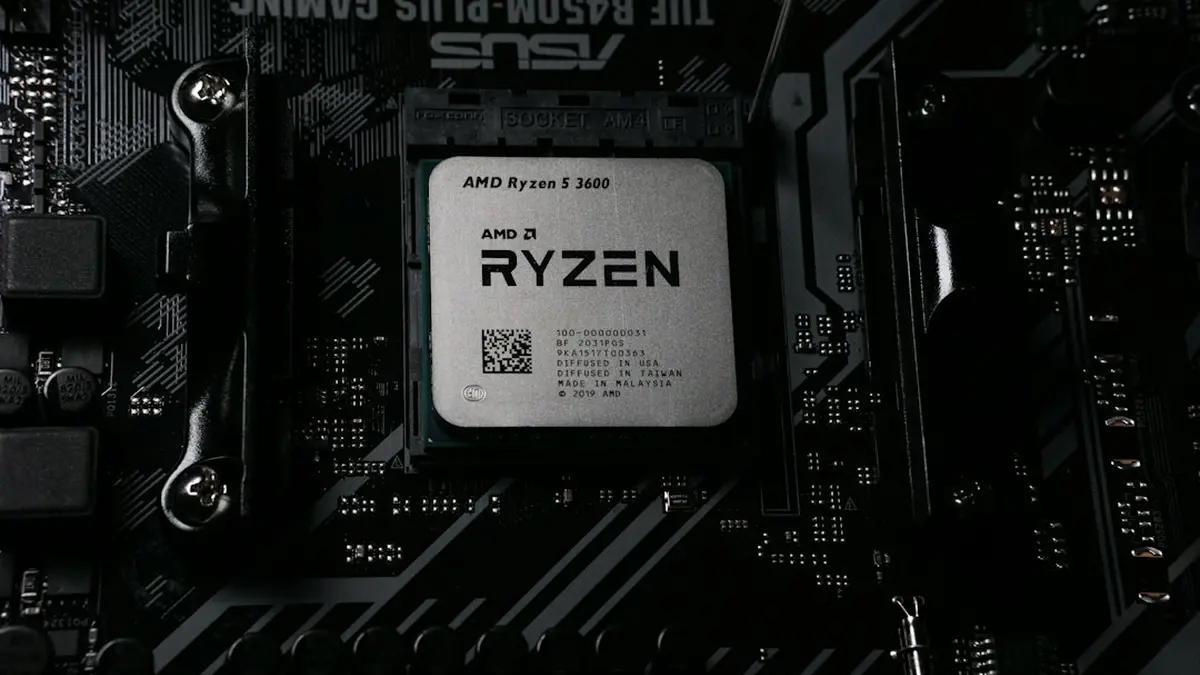
Buy the Ryzen 9 9950X3D. The Ryzen 9 9950X3D2 Dual Edition is faster by about 4 to 6 percent in multi-threaded work and by close to nothing in games. On PassMark's comparison page, stamped 20 November 2026, it also costs $209 more, and it draws more power and needs a bigger radiator. The choice comes down to whether a second stack of V-Cache is worth paying about a third more for each point of performance. For almost everyone, it is not.
AMD launched the X3D2 on April 22, 2026 at $899, against $699 at launch for the Ryzen 9 9950X3D. Since then, every published review has said much the same thing, with different amounts of politeness. GamersNexus put it in the headline: "DO NOT BUY."
The two chips, row by row
| Specification or result | Ryzen 9 9950X3D2 Dual Edition | Ryzen 9 9950X3D |
|---|---|---|
| Cores / threads | 16 / 32 | 16 / 32 |
| Base / max boost clock | 4.3GHz / 5.6GHz | 4.3GHz / 5.7GHz |
| L2 cache | 16MB | 16MB |
| L3 cache | 192MB (96MB stacked on each CCD) | 128MB (V-Cache on one CCD) |
| TDP | 200W | 170W |
| Default PPT (Puget Systems) | 270W | 200W |
| Socket | AM5 | AM5 |
| Released | April 22, 2026 | March 12, 2025 |
| Launch price | $899 | $699 |
| Listed price, PassMark, 20 Nov 2026 | $799 | $589.99 |
| AMD minimum cooler, per Club386 | 360mm radiator | 240/280mm radiator |
| Geekbench 6 single-core, Geekbench Browser, 16 Sep 2026 | 3,163 | 3,058 |
| Geekbench 6 multi-core, Geekbench Browser, 16 Sep 2026 | 28,167 | 26,572 |
| Cinebench 2024 multi-core, Tom's Hardware, 21 Apr 2026 | 2,529 | 2,423 |
| Counter-Strike 2 1080p Ultra, Tom's Hardware, 21 Apr 2026 | 732 fps | 742 fps |
| Rainbow Six Siege 1080p avg, Club386 | 491 fps | 478 fps |
| System power in Cinebench 2026 nT, Club386 | 417W | 345W |
| CPU Mark, PassMark, 20 Nov 2026 | 72,085 | 70,108 |
| Single Thread Rating, PassMark, 20 Nov 2026 | 4,671 | 4,737 |
| CPU Value (Mark per dollar), PassMark, 20 Nov 2026 | 90.2 | 118.8 |
| Estimated yearly running cost, PassMark | $36.50 | $31.03 |
Two gaps in the published record. None of the sources quoted here lists official memory support for either chip. Club386 gives the X3D2's Cinebench 2026 multi-thread score (10,157) and the percentage lead, but not the 9950X3D's raw score, so that test appears below as a delta and not as a row. Both chips are in the compare tool, alongside the rest of the processor table.
Ryzen 9 9950X3D2 vs Ryzen 9 9950X3D in the hub
| Ryzen 9 9950X3D2 | Ryzen 9 9950X3D | |
|---|---|---|
| Price | $899launch price | $699launch price |
| Cores | 16 | 16 |
| Threads | 32 | 32 |
| Base clock | 4.3 GHz | 4.3 GHz |
| Boost clock | 5.6 GHz | 5.7 GHz |
| Geekbench 6 CPUSingle-core, points | 3,163 | 3,058 |
| Geekbench 6 CPUMulti-core, points | 28,167 | 26,572 |
| Cinebench 2024Multi-core, points | 2,529 | 2,423 |
| Counter-Strike 21080p Ultra, fps | 732 | 742 |
| Cyberpunk 20771080p Ultra, fps | 141 | 141 |
| Blender Benchmarksamples/min | 687 | 663 |
| Buy | Check price on AmazonCheck price at Best Buy | Check price on AmazonCheck price at Best Buy |
Figures as published by Blender Open Data (Oct 19, 2026), Geekbench Browser (Sep 16, 2026), Tom's Hardware (Apr 21, 2026), Tom's Hardware (Apr 21, 2026). The best figure is marked where a row is all one source.
Compare every benchmark side by sideAMD Ryzen 9 9950X3D2 Dual Edition
"Dual Edition" means the stacked cache sits on both chiplets. The 9950X3D puts its 3D V-Cache on one of its two 8-core CCDs, which gives it 128MB of L3, and the other CCD runs with ordinary cache. According to Club386's review, the X3D2 stacks 96MB on each CCD for 192MB in total, 50 percent more. AMD had avoided caching both dies because of thermal and power density, as TweakTown reported before launch. The shipping chip shows the cost of doing it anyway: boost drops 100MHz to 5.6GHz, TDP rises from 170W to 200W, and PPT goes to 270W. The pre-launch leak had put PPT at 250W.
AMD's marketing, as quoted by Club386, calls it "the ultimate processor for the developers and creators" and also "for a very specific user who needs top performance for multi-threaded latency-sensitive workloads." The second description is the accurate one.
The gains are real and they are small. Club386's head-to-head had it 4.2 percent ahead in Cinebench 2026 multi-thread (10,157 points), 4.2 percent ahead in Corona 10 and 4.8 percent ahead in Geekbench 6 multi-core. It saved 2.5 seconds in Y-Cruncher, was 1.36 percent ahead in 7-Zip and under 1 percent ahead in Photoshop and Premiere Pro. In Puget Systems' creator suite the leads were 7 percent in Blender, V-Ray and an Unreal Engine compile, 6 percent in Cinebench 2026 multi-thread, 5 percent in KeyShot, 4 percent in Photoshop (13,278 overall), 3 percent in DaVinci Resolve and 2 percent in Corona. Houdini simulation took 998.9s against 1,037.1s, and Premiere Pro was within margin of error. GamersNexus measured the largest single gain, 9 percent in 7-Zip compression, plus a Chromium compile at 88.1 minutes against 95 and a Blender render at 5.8 minutes against 5.9. Tom's Hardware's faceoff found AV1 decoding through dav1d about 5 percent faster at 4K and 1080p. PCWorld, citing Tom's Hardware, reports gains of about 20 percent in chess engines and Linpack, which are the cache-bound outliers.
Club386's 7-Zip figure (1.36 percent) and GamersNexus's (9 percent) are different tests on different benches, and they are not averaged here. On the hub's own figures, Cinebench 2024 multi-core is 2,529 against 2,423 (Tom's Hardware, 21 April 2026), 4.4 percent. Geekbench 6 multi-core is 28,167 against 26,572 (Geekbench Browser, 16 September 2026), 6.0 percent.
It falls short on price, heat and comparison with Intel. Puget found the Core Ultra 7 270K Plus, a $300 launch part, ahead of the X3D2 in Lightroom Classic, Premiere Pro overall, Cinebench 2026 multi-thread (by 1 percent) and the full Houdini run (927.99s). Club386 calls it "the hottest current-generation CPU" it has tested.
Who should buy it: someone whose renders or compiles are billed by the hour and who already owns a 360mm-class cooler.
AMD Ryzen 9 9950X3D
It has the same 16 cores, a 100MHz higher boost, 30W less TDP, and the chip AMD's own Dual Edition fails to beat in most games. Single-thread results run both ways depending on the test. PassMark's Single Thread Rating has the 9950X3D ahead, 4,737 to 4,671, and Club386 had it slightly ahead in Cinebench 2026 single-thread. Puget had the X3D2 2 percent ahead in that same test, and Geekbench Browser lists 3,163 against 3,058 (16 September 2026). Read together, that is a tie.
Games are where the extra cache was supposed to matter, and the results are mixed. In Counter-Strike 2 at 1080p Ultra, the 9950X3D posted 742 fps to the X3D2's 732 (Tom's Hardware, 21 April 2026). In Club386's 1080p runs on an RTX 5090, the X3D2 gained 9 fps on average and 11 fps on minimums in Cyberpunk 2077, went from 478 to 491 fps in Rainbow Six Siege (2.7 percent) and gained about 2 percent in Final Fantasy XIV. It showed no meaningful gain in Civilization VI, Total War: Warhammer III or F1 25, and in F1 25 its minimum frame rate was 28 percent lower. Absolute frame rates for those last three titles are not in the figures available to this piece. GamersNexus measured +5 percent in Baldur's Gate 3 (178 fps average), +4.8 percent in Dragon's Dogma 2 (138 fps) and +2.6 percent in Kingdom Come: Deliverance II. Cyberpunk 2077 at High and Starfield were tied, and Outer Worlds 2 showed nothing. PCWorld put the gap within 1 to 2 points, inside run-to-run variance. HowManyFPS goes the other way and rates the 9950X3D about 20 percent faster across more than 100 games. That aggregate disagrees with every bench-tested source, so it gets little weight here.
The 9950X3D's price has come down. It launched at $699, GamersNexus saw about $657 at the X3D2's launch, Club386 saw about $659, and PassMark lists it at $589.99 as of 20 November 2026. It pulled 345W at the wall in Club386's Cinebench run, and AMD rates a 240mm or 280mm radiator as enough.
Who should buy it: anyone who wants 16 cores and X3D gaming in one socket, which covers nearly everyone considering either chip.
What separates them
Performance per dollar. PassMark's CPU Value metric gives the 9950X3D 118.8 and the X3D2 90.2, so the cheaper chip delivers about 32 percent more CPU Mark per dollar at the 20 November 2026 listed prices. Club386 estimates about 30 percent better value, and its own Productivity Value Rating puts the X3D2 at 11.30, 24 percent below the 9950X3D. The arithmetic below shows where the price gap would have to fall before the answer changed.
At what price gap the X3D2 makes sense
Points per dollar using Tom's Hardware's Cinebench 2024 multi-core scores (21 April 2026) and Geekbench Browser multi-core scores (16 September 2026), priced at PassMark's listing (20 November 2026) and at launch.
| 9950X3D, Cinebench 2024, $589.99 | 4.11 points per dollar |
|---|---|
| 9950X3D2, Cinebench 2024, $799 | 3.17 points per dollar |
| 9950X3D at $699 launch | 3.47 points per dollar |
| 9950X3D2 at $899 launch | 2.81 points per dollar |
| X3D2 price that matches the 9950X3D (Cinebench 2024, +4.4%) | $615.80 |
| X3D2 price that matches the 9950X3D (Geekbench 6 multi, +6.0%) | $625.40 |
The X3D2 only matches the 9950X3D on value when it costs about $26 to $35 more. The listed gap is $209, and Club386 measured a $242 street gap, so the gap would need to close by roughly $175 before the X3D2 makes sense.
Power and heat. Club386 measured 417W at the wall in Cinebench 2026, 72W (21 percent) more than the 9950X3D and a record for its suite. The X3D2 also ran 12°C hotter, peaking at 82 to 84°C under an Arctic Liquid Freezer III Pro 420. GamersNexus measured about 294W peak on the EPS12V rail in Blender, with HWiNFO reporting about 250W. The electricity barely matters: PassMark estimates $5.47 a year between them. The cooler does matter. AMD's 360mm minimum against 240/280mm can mean a bigger radiator, and on a small case a different case, so it is worth checking against the cooler options for these chips before paying the CPU premium.
Games do not use the second cache. On the 9950X3D, a game that fits on eight cores can already run on the cached CCD, so caching the second die only helps work that spreads across all 16 cores at once. The benchmarks match that: 0 to 6 percent in games and 0 to 9 percent in production work. On local AI, nothing in the published record measures LLM tokens per second or images per minute on both chips. The one llama.cpp figure, from Puget, has the X3D2 generating tokens about 35 percent slower than the $300 Core Ultra 7 270K Plus. In a local AI box, the LLM inference numbers come from the GPU, not from this $209.
Verdict
New build, games plus real work: buy the Ryzen 9 9950X3D. It matches the X3D2 in games, comes within 4 to 6 percent of it in multi-threaded work, runs on a 240mm cooler and cost $589.99 on PassMark's 20 November 2026 listing.
Games only: buy neither. GamersNexus pointed gamers to the Ryzen 7 9800X3D (about $464 at the time) or the 7800X3D (about $389), and the 9800X3D already matches the 9950X3D in Cyberpunk 2077 and Counter-Strike 2.
Rendering or compiling for money all day, with a 360mm or larger cooler already installed: the X3D2 saves 4 to 7 percent of render and compile time in Club386's and Puget's results. At a $209 premium that is a poor deal. The answer changes when the gap falls to around $35, so wait for a price drop.
Already own a 9950X3D: keep it. Spending $799 for 0 to 9 percent is a sidegrade, and it comes with a hotter chip.
AMD Ryzen 9 9950X3D
- Geekbench 6 CPU Single-core 3,058 points Geekbench Browser, Sep 16, 2026
- Geekbench 6 CPU Multi-core 26,572 points Geekbench Browser, Sep 16, 2026
AMD Ryzen 9 9950X3D2 Dual Edition
- Geekbench 6 CPU Single-core 3,163 points Geekbench Browser, Sep 16, 2026
- Geekbench 6 CPU Multi-core 28,167 points Geekbench Browser, Sep 16, 2026
Comments
No comments yet. Be the first to comment!
Leave a Comment