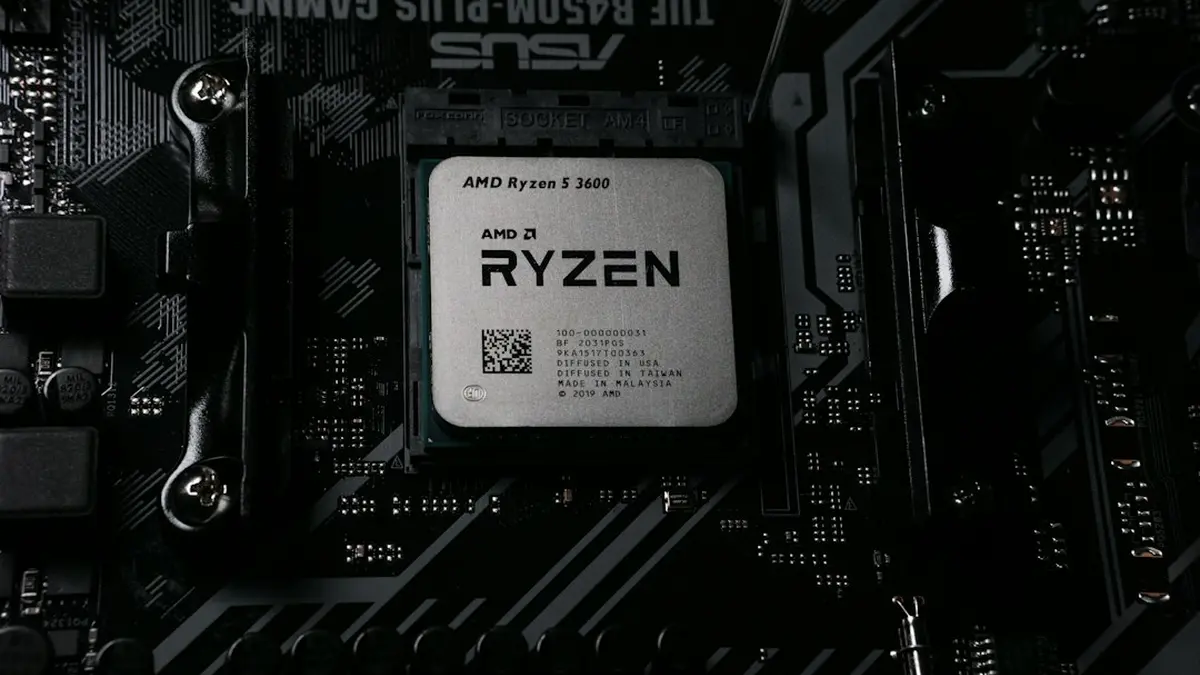
For most buyers the AMD Ryzen 7 9800X3D is the one to get. The AMD Ryzen 7 9850X3D is the same eight-core chip with the same 96MB of L3 and a boost clock 400MHz higher. In 3DCenter's aggregate of 14 launch reviews, reported by Notebookcheck, that clock bought 3.2% more gaming frame rate and cost 32% more power. The newer chip only makes sense in a new build, and only when it sells for no more than about $15 over the older one.
The 9850X3D went on sale on January 29, 2026 at a $499 MSRP. The 9800X3D launched at $479 in November 2024. AMD's own marketing claimed a 7% uplift. Independent reviewers measured 0.5 to 5%, depending on resolution and which games they ran. We have no retail price from November 2026 for either chip, so the prices below are the ones each source reported on its own date. Check the price on Amazon before you act on any of them.
Spec sheet and published results
| AMD Ryzen 7 9850X3D | AMD Ryzen 7 9800X3D | |
|---|---|---|
| Cores / threads | 8 / 16 | 8 / 16 |
| Base / boost clock | 4.7GHz / 5.6GHz | 4.7GHz / 5.2GHz |
| L3 cache | 96MB | 96MB |
| TDP / PPT | 120W / 162W | 120W / 162W |
| Socket | AM5 | AM5 |
| Released | January 29, 2026 | November 7, 2024 |
| Launch MSRP (US) | $499 | $479 |
| Post-launch sale prices reported by Tom's Hardware | $454 (Newegg, first major discount) | $443; $429 historic low |
| Geekbench 6 single-core, Geekbench Browser (Sep 16, 2026) | 3,122 | 2,968 |
| Geekbench 6 multi-core, Geekbench Browser (Sep 16, 2026) | 19,488 | 18,740 |
| Cinebench 2024 single-core, Club386 | 142 | 133 |
| Cinebench 2024 multi-core, Tom's Hardware (Apr 21, 2026) | 1,392 | 1,375 |
| Counter-Strike 2 1080p Ultra, Tom's Hardware (Apr 21, 2026) | 758 fps | 736 fps |
| 16-game 1080p geomean, RTX 5090 FE, Tom's Hardware | 211.2 fps | 204.6 fps |
| Gaming power draw, Tom's Hardware | 106W | 81.4W |
| Gaming temperature, Tom's Hardware | 61°C | 58°C |
| Average power draw, 3DCenter aggregate | 104W | 79W |
| Frames per watt, Tom's Hardware | 1.99 | 2.51 |
| Frames per dollar, Tom's Hardware | 0.42 | 0.44 |
The Geekbench and Counter-Strike 2 rows come from the hub's Geekbench 6 and Counter-Strike 2 tables. On those, the 9850X3D leads by 5.2% in single-core, 4.0% in multi-core and 3.0% in CS2. Its lead in Cinebench 2024 multi-core is 1.2%. The page-one reviews also ran Forza Motorsport, Total War: Warhammer III, Final Fantasy XIV: Dawntrail, Mount & Blade II: Bannerlord, 3DMark Speed Way and Steel Nomad, y-cruncher, PCMark 10, UL Procyon, SPECworkstation, Blender and 7-Zip. Their per-title results are not in the material this piece draws on, so they are left out rather than guessed.
AMD Ryzen 7 9850X3D
Every outlet agrees it is the fastest gaming CPU they tested. They disagree only on how far ahead it is. Tom's Hardware's review put it at 3.3% over the 9800X3D on average, under the headline "The world's fastest gaming processor, again". TechSpot found about 5% across 14 games. TechPowerUp found 2.5% at best and 0.5% at 4K, where the GPU sets the pace.
The gains are uneven, as you would expect from a clock bump. In Tom's Hardware's 16-game suite, as summarized here, Flight Simulator 24 gained 6.2%, F1 2024 4.7% and A Plague Tale: Requiem 2.8%. The 1% lows in DOOM: The Dark Ages rose 12.6%. Starfield, Monster Hunter Wilds and Cyberpunk 2077 showed no meaningful difference. Club386 measured a 2fps higher average in Rainbow Six Siege X, but the minimum frame rate there was 5fps worse.
Outside games, Tom's Hardware found a 5 to 7% lead in lightly threaded work and roughly 6.5% in single-threaded Cinebench 2024, POV-Ray and LAME. Heavily threaded workloads ran "in lockstep". Notebookcheck's full review put the cumulative CPU gain at about 3%, with Cinebench R23 single-core at 2,228 against 2,080. Its verdict was "essentially just a better-binned 9800X3D". KitGuru scored it 7.5/10 and called it "an incremental update".
It is the chip for a new AM5 build with a fast GPU, played at 1080p, where the price gap is small and frame rate is the only thing that counts.
- Highest gaming frame rates in Tom's Hardware, TechSpot and TechPowerUp testing
- 5 to 7% ahead in lightly threaded work (Tom's Hardware)
- Drop-in on AM5; one V-Cache CCD, so no scheduling issues (Notebookcheck)
- 106W against 81.4W in gaming, 61°C against 58°C (Tom's Hardware)
- About 20% fewer frames per watt (Tom's Hardware)
- Poor 3DMark scores against competitors (Notebookcheck)
AMD Ryzen 7 9800X3D
The older chip is within a few percent everywhere it was measured. It trails by 1.2% in Cinebench 2024 multi-core and by 22fps out of 736 in Counter-Strike 2 (both Tom's Hardware, April 21, 2026). It wins on every efficiency metric anyone published. Tom's Hardware measured 2.51 frames per watt against 1.99 and 0.44 frames per dollar against 0.42. Club386's efficiency and productivity-value ratings also went its way, at 5.12 against 5.02 and 2.80 against 2.73. Tom's Hardware notes that turning on PBO closes much of the gaming gap, which is a fair description of what the 9850X3D is: a factory overclock.
Its price has also moved in the right direction. After the 9850X3D launched, Tom's Hardware reported the 9800X3D at $443, down from $479, and separately at a historic low of $429. Street prices ran from $430 to $470, which put it $30 to $70 below the newer chip. Those figures date from the weeks after launch. We have no November figure.
It is the chip for anyone building to a budget, anyone with a mid-size air cooler, and anyone who plays at 1440p or 4K. If you are weighing it against something cheaper still, the gap to the 7800X3D is larger than this one.
AMD Ryzen 7 9850X3D
- Geekbench 6 CPU Single-core 3,122 points Geekbench Browser, Sep 16, 2026
- Geekbench 6 CPU Multi-core 19,488 points Geekbench Browser, Sep 16, 2026
AMD Ryzen 7 9800X3D
- Geekbench 6 CPU Single-core 2,968 points Geekbench Browser, Sep 16, 2026
- Geekbench 6 CPU Multi-core 18,740 points Geekbench Browser, Sep 16, 2026
The difference that matters
Watts per frame. About 3% more frame rate costs 25W more in gaming: 106W against 81.4W at Tom's Hardware, and 104W against 79W in 3DCenter's aggregate. The measurements do not all agree. Notebookcheck's own review found gaming draw marginally lower on the 9850X3D, though it still rated the 9800X3D slightly more efficient overall. Notebookcheck's news desk warned that a cooler sized for the 9800X3D may not cope with the 9850X3D. No source here names a radiator size. If yours is borderline, our cooler picks are matched to what current chips draw.
Resolution. The lead shrinks to 0.5% at 4K (TechPowerUp), because the GPU becomes the limit. Most of the measured gains come from 1080p runs with an RTX 5090 or RTX 4090. Pair either chip with a mid-range card and the two will produce the same frame rate.
Local AI. None of these sources published LLM tokens-a-second or images-a-minute figures for either chip, and the hub's LLM inference table has none for them yet. The closest proxy is multi-threaded throughput, where they sit 1.2 to 4% apart. If you run models on the CPU, neither eight-core part is the right buy. The Ryzen 9 9950X3D scores 26,572 in Geekbench 6 multi-core (Geekbench Browser, September 16, 2026) against 19,488, and its dual-CCD layout is the scheduling issue Notebookcheck says the 9850X3D avoids. The Core Ultra 9 285K scores 25,837 on the same chart, but trails the 9850X3D in games by 32% in the 3DCenter aggregate. That aggregate also puts the 9850X3D 5% ahead of the 9950X3D in games.
Ryzen 7 9850X3D vs 9800X3D in the hub
| Ryzen 7 9850X3D | Ryzen 7 9800X3D | |
|---|---|---|
| Price | $499launch price | $479AMD's suggested price |
| Cores | 8 | 8 |
| Threads | 16 | 16 |
| Base clock | 4.7 GHz | 4.7 GHz |
| Boost clock | 5.6 GHz | 5.2 GHz |
| Geekbench 6 CPUSingle-core, points | 3,122 | 2,968 |
| Geekbench 6 CPUMulti-core, points | 19,488 | 18,740 |
| Cinebench 2024Multi-core, points | 1,392 | 1,375 |
| Counter-Strike 21080p Ultra, fps | 758 | 736 |
| Cyberpunk 20771080p Ultra, fps | 148 | 143 |
| Blender Benchmarksamples/min | 345 | 334 |
| Buy | Check price on AmazonCheck price at Best Buy | Check price on AmazonCheck price at Best Buy |
Figures as published by Blender Open Data (Oct 19, 2026), Geekbench Browser (Sep 16, 2026), Tom's Hardware (Apr 21, 2026), Tom's Hardware (Apr 21, 2026). The best figure is marked where a row is all one source.
Compare every benchmark side by sideAt what price gap the answer flips
Break-even on cost per frame
Take 3DCenter's 3.2% gaming lead at face value. That is a 1080p figure; at 4K TechPowerUp's 0.5% makes the break-even gap a few dollars. The 9850X3D matches the 9800X3D on cost per frame when it costs no more than 1.032 times the older chip's price. Prices are the reported ones, on their dates.
| 9800X3D at $479 MSRP: break-even 9850X3D price | $494 |
|---|---|
| 9850X3D MSRP | $499 (about $5 over break-even) |
| 9800X3D at $443 (Tom's Hardware sale): break-even | $457 |
| 9850X3D at $454 (Newegg discount) | $3 under break-even |
| 9800X3D at $429 (historic low): break-even | $443 |
Verdict
Buy the Ryzen 7 9800X3D unless the 9850X3D is within roughly $15 of it on the day you buy. In that case, take the 9850X3D for a 1080p, high-refresh build with a large cooler. If you already own a 9800X3D, do not upgrade. Notebookcheck's line, "$20 more for 2-3% gains at best", is generous to the idea, and the gap is smaller than what PBO gets you on the chip you have. If you game at 1440p or 4K, buy the cheaper chip at any gap. Windows Central put it most bluntly: the 9850X3D "will live or die on the 9800X3D's pricing", and the discounts on the older chip after launch did not help it.
Comments
No comments yet. Be the first to comment!
Leave a Comment